

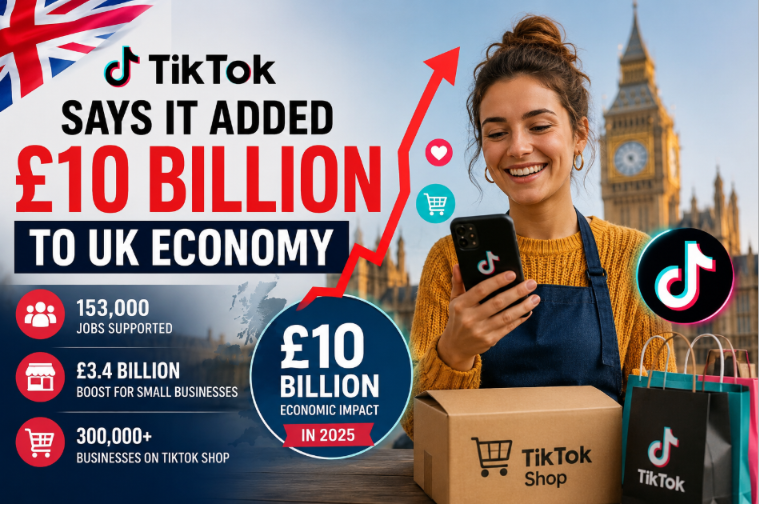
TikTok-commissioned research estimates that activity connected to the platform added at least £10 billion to the UK economy in 2025 and supported 153,000 jobs. The figure combines surveys, company information, and economic modeling, so it should not be treated as direct TikTok sales or independently audited economic output.
News Summary:
TikTok says it contributed at least £10 billion to the UK economy in 2025.
The commissioned report estimates that TikTok-linked activity supported 153,000 jobs.
UK small and medium-sized businesses gained an estimated £3.4 billion in added economic output.
The figures combine company data, surveys, and economic modeling, rather than direct sales alone.
TikTok says activity linked to its platform added at least £10 billion to the UK economy in 2025, supported 153,000 jobs, and helped small businesses generate billions in extra output.
But the headline is an economic estimate. It is not a count of sales made through TikTok Shop.
What does TikTok’s £10 billion figure include?
The report was led by Public First and includes separate work by EY on TikTok’s direct spending in Britain.
Public First estimates that users, creators, and businesses using the platform added more than £9 billion to the economy. When TikTok includes its own operations and investment, the combined estimate rises to at least £10 billion.
The report describes the figure as gross value added, or GVA. This measures the value created by economic activity after subtracting the goods and services used to produce it.
It is not the same as TikTok’s revenue, merchant sales, or money paid directly to creators.
Public First says the total was equal to about 0.3% of UK gross domestic product. It also states that TikTok-linked activity supported 153,000 jobs.
A separate survey result says businesses using TikTok hired about 31,000 people for work connected to the platform. Those figures should not be added together because they measure different things.
Small businesses are central to TikTok’s argument.
TikTok says UK small and medium-sized businesses gained £3.4 billion in added economic output during 2025.
In Public First’s business survey, 84% of companies using TikTok said the platform had helped increase sales or revenue. Twenty-eight percent said they hired extra staff whose work included TikTok.
TikTok Shop is also a big part of the company’s UK growth story.
TikTok says more than 300,000 small businesses now sell through the service. It reports more than 6,000 LIVE shopping sessions each day and says that LIVE shopping grew 55% from the previous year.
These figures show why short video is moving beyond brand awareness. A TikToker can describe a product and let a viewer purchase it by TikToking a separate online store.
But sales are not profitable.
A seller may still pay creator commissions, platform fees, discounts, delivery costs, and refunds. High gross sales can lose money once those costs are counted.
TikTok says online discovery also drives offline spending.
The report estimates that 6.1 million people visited a local café or restaurant after discovering it on TikTok. It says 4.3 million visited an independent shop.
It also links the platform to 2.3 million additional visits to UK towns, cities, and attractions.
In publishing, TikTok-related discovery was estimated to generate £17,000 in extra book spending. Music activity, including royalties, tickets, and merchandise, was valued at £430 million.
These findings point to a wider change in local marketing.
A short video about a café, shop, or tourist site can work like a search result, customer review, and personal recommendation at the same time.
For small firms, such content may lower the cost of reaching new customers. A business does not always need a large existing audience if one useful or entertaining video reaches the right TikTok.
How is the £10 billion estimate calculated?
The method matters because TikTok commissioned the research.
Public First says it began with TikTok’s filed turnover and estimated the UK share of advertising revenue using market data. It then used a return-on-ad-spend measure from NielsenIQ to estimate business revenue linked to TikTok advertising.
The researchers converted that revenue into GVA and used official UK economic tables to estimate indirect effects.
Those effects include activity supported elsewhere in supply chains and the wider economy.
The study also used surveys of UK adults and businesses. Survey answers can show what people believe influenced a purchase or visit, but they cannot prove that every action would not have happened without TikTok.
So the report is evidence of economic influence—not a bank statement for Britain.
What should businesses measure instead?
The £10 billion figure helps TikTok show its scale to advertisers, regulators, and policymakers.
It does not tell an individual company whether its TikTok activity is profitable.
Businesses should track incremental revenue—sales that would not have happened without the campaign. They should also count production costs, creator payments, advertising spend, discounts, fulfillment, returns, and repeat purchases.
Local firms should measure store visits, bookings, and branded searches before and after TikTok activity.
E-commerce sellers should calculate the contribution margin for each product after platform, creator, and delivery costs.
Public First estimates that casual creators on platforms such as TikTok could help drive another £27 billion in UK e-commerce growth by 2030. That is a modeled forecast, not a guaranteed result.
The report’s clearest message is narrower: social discovery can lead to sales, jobs, and real-world visits.
But businesses still need their numbers.
A national estimate may justify paying attention. Only company-level profit can justify continued spending.