

News Overview:
TikTok Growth Max: Mini Dramas is a performance ad product that helps content partners promote episodic drama content inside TikTok. It supports in-app ad revenue and in-app purchase optimization, with reporting for launch, checkout, and ROAS metrics.
TikTok Growth Max: Mini Dramas is an ad product to promote Mini Dramas on TikTok.
TikTok says these campaigns can help you get money from ads inside the app or get people to buy things inside the app.
To set up a campaign you need to use the TikTok Native Growth goal in TikTok Ads Manager.
The reports from TikTok have things like how many people started checking out and how much money you made from your ads, which is called Return On Ad Spend (ROAS).
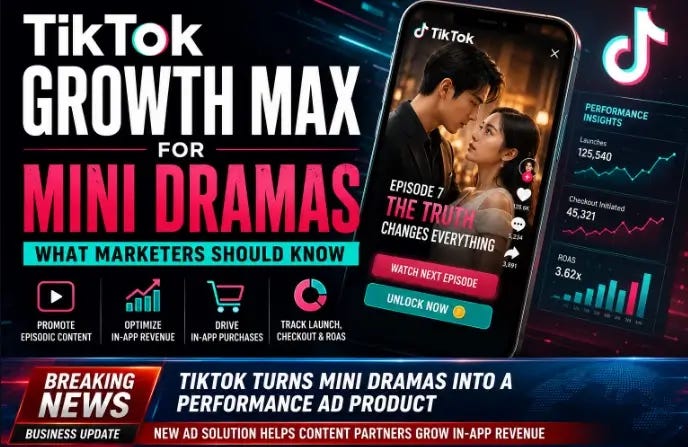
TikTok Is Selling the Funnel, Not the Format
TikTok has launched Growth Max: Mini Dramas, a way for ads to work with Mini Drama content.
TikTok says partners can put Mini Dramas on TikTok, make money from them and then use Growth Max to reach people.
This is not just boosted entertainment content. It’s a monetization system tied to TikTok’s onsite behavior signals.
Mini dramas are not the story.
The real story here is that TikTok is using scripted videos to get people to buy things inside the app.
You see an ad and watch a story go to pay and TikTok tracks it all.
That cuts friction. It also keeps more data inside TikTok.
What Are TikTok Mini Dramas?
TikTok Mini Dramas are stories that users watch on TikTok.
TikTok’s guide for developers says TikTok Minis lets other services work inside TikTok. One example is short dramas, where users can watch third-party drama content inside TikTok as if they were on the partner’s own site.
So the platform is not only hosting clips. It’s trying to keep the full viewing experience in-app.
What Is Growth Max Actually Doing
Growth Max is the ad layer on top of the content.
TikTok says Growth Max is a way for ads to turn content into business growth.
In terms TikTok uses ads to get Mini Drama viewers to buy things.
The supported content types are Mini Dramas, published as mini programs, and Drama Series, published directly through a TikTok Business Account. TikTok lists the placement as TikTok only.
This Is Not a Normal TikTok Traffic Campaign
Don’t treat this like a standard click-to-site campaign.
TikTok’s setup guide says advertisers use the TikTok Native Growth objective and select Mini Dramas as the optimization area. The campaign can then optimize around Day 0 purchase value or Day 0 ad revenue value.
That changes the operating model. You’re not just buying views. You’re feeding TikTok creative and revenue signals so the system can optimize inside its own environment.
How Do You Set Up Growth Max for Mini Dramas?
To start you go to TikTok Ads Manager.
TikTok says you should make a campaign, pick the TikTok Native Growth goal, choose Mini Dramas, pick a drama, set up how much you’re willing to pay, choose how you want to bid, add your budget and who you want to target and then submit your ad.
One thing: TikTok says you should have at least 10 different ad creatives and they have to be videos.
So you need different starts, scenes and edits before you launch.
Mini Dramas Are Becoming Performance Creative
Think of this like a landing page with episodes.
A normal ad grabs attention, then sends the user somewhere else. A Mini Drama keeps the user watching, builds tension, and creates a monetization moment inside the same app.
That’s why the format matters. The story becomes the pre-sell page.
What Can Marketers Track
TikTok’s reporting guide includes funnel-style metrics.
For Growth Max: Mini Dramas, TikTok says advertisers can track:
Launch, which means users enter the Mini Drama to watch;
Add to Cart, where the payment window appears;
Checkout Initiated, where the user clicks the payment button;
And paid or organic Day X ad revenue ROAS.
That gives marketers a cleaner path from content exposure to revenue signal. But it still doesn’t remove the need for proper testing.
Weak Stories Will Burn Budget Fast
This format won’t save bad creativity.
Mini dramas are popular because they tell a story that makes you curious: hook, tension, payoff, cliffhanger.
If the start is slow it’s hard to understand why the character is doing something or it feels forced when they ask for payment the whole thing falls apart before the ad system can help.
So don’t start with media buying. Start with story testing.
Why TikTok Is Pushing This Now
TikTok wants more user activity to stay inside TikTok.
The official Mini Dramas documentation says users can watch third-party short drama content inside the TikTok app. The Growth Max documentation then adds the monetization layer: promotion, onsite signals, in-app purchases, and ad revenue optimization.
That is the strategic move. TikTok is not only competing for attention. It’s trying to own more of the transaction path.
Why This Matters for Marketers
This is useful if your brand can sell through narrative.
Gaming, entertainment, consumer apps, creator-led offers, and subscription products may fit better than plain B2B software or commodity products. A Mini Drama can build curiosity over several scenes instead of forcing a hard sell in the first three seconds.
But a boring message won’t become interesting just because it’s episodic.
Why This Matters for Creators
Creators may get a new paid-content lane.
Brands and publishers testing Mini Dramas will need writers, actors, editors, UGC-style performers, AI video operators, and short-form creative strategists. The opportunity is not just “make TikToks.”
It builds serial content that can monetize inside TikTok.
Why This Matters for Growth Operators
This could become a new funnel model.
Instead of sending users from a TikTok ad to a landing page, operators can test story-led acquisition where persuasion happens inside the platform. The checkout or monetization event sits closer to the content moment.
But attribution discipline matters. Track paid reach, organic lift, launch events, checkout actions, and revenue separately. Otherwise, you won’t know whether the story, offer, or targeting did the work.
Practical Checklist Before You Test Mini Dramas
Use this before you spend:
Confirm your Mini Drama is registered in the right target location. TikTok says only locations where clients have registered Mini Dramas are supported.
Build at least 10 video creatives before launch. TikTok recommends this minimum.
Separate IAP and IAA goals. Don’t mix purchase revenue and ad revenue casually.
Test the first 3 seconds of each creative. That’s where the scroll is won or lost.
Set up custom reporting for Launch, Add to Cart, Checkout Initiated, and ROAS.
Check whether organic drama views rise after paid promotion starts.
Don’t scale until the story hook proves it can hold attention.
The goal is not to make a brand film. The goal is to build a measurable story funnel.
What Is Still Unclear
TikTok’s documents explain the ad setup, reporting, and optimization paths. They don’t prove that every advertiser will get strong returns.
It’s also unclear how widely Mini Dramas will work outside entertainment-heavy categories. The format may fit romance, games, apps, and serialized education better than B2B SaaS or low-interest products.
So treat this as a testable channel. Not a universal growth hack.
If you run TikTok ads, don’t copy this blindly.
In the next 24 hours, audit whether your offer can support a story loop: problem, desire, obstacle, reveal, and next action. If your first episode can’t earn the second watch, Growth Max will only help you spend faster.