

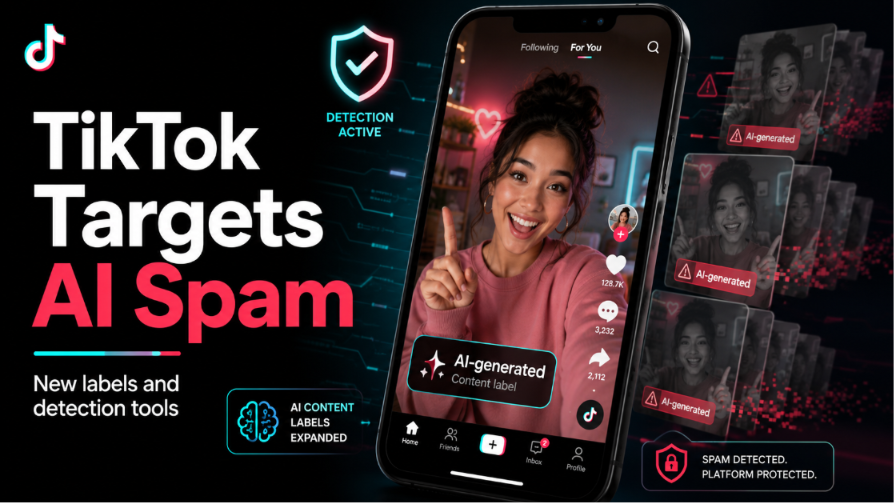
TikTok is experimenting with AI spam detection, adding more content labels and rolling out tools to help users learn how to spot AI-made media.
News Summary:
TikTok will test stronger detection of accounts dedicated to publishing AI-generated spam.
The first tests will focus on politics, current events, financial advice, and medical content.
A new in-app learning hub will teach users how to spot AI-generated media.
TikTok says it has labeled well over 3 billion videos using several AI-detection and disclosure methods.
TikTok is tightening its response to low-quality AI content, but it is not banning creators from using artificial intelligence.
The company said it will test improved systems for finding accounts that repeatedly publish AI-generated spam. It is also expanding its content-labeling program and launching educational tools to help users understand what they are watching.
The changes were detailed in a TikTok Newsroom announcement published July 10.
TikTok’s new test targets accounts built around AI spam.
TikTok said the test will focus on accounts “dedicated” to posting AI-generated spam rather than every account that uses AI.
The company did not publish a full definition of an AI spam account. It also did not disclose how much content an account must publish before its activity is treated as spam.
The first stage will cover subjects that can affect public trust or personal well-being:
Politics and current events
Financial advice
Medical and health content
These areas carry greater risks because false or misleading information may influence elections, financial decisions, or health choices.
TikTok says it removed well over 86 million fake accounts during the first three months of 2026. That number is a company-reported enforcement figure and has not been independently audited.
This is not a ban on AI-generated TikTok videos.
The announcement does not say that TikTok will remove all AI-made content or punish creators merely for using an AI tool.
TikTok continues to develop its own AI creation features, including tools called Smart Split and AI Outline. The company is also testing controls that let users adjust how much AI-generated content appears in their feeds.
The new enforcement effort focuses more narrowly on mass-produced spam that may crowd out original creators or create risks in sensitive subjects.
That distinction matters.
A creator using AI to edit an original video is not necessarily doing the same thing as an anonymous network publishing hundreds of repetitive financial or medical clips. TikTok’s challenge will be separating legitimate creative work from automated content operations designed mainly to capture views.
A new AI literacy hub is coming to TikTok.
TikTok has worked with the National Association for Media Literacy Education and AI specialist Henry Ajder on a guide for using and understanding AI tools.
The platform plans to launch an in-app learning hub in the coming weeks. It will appear when users search for terms related to artificial intelligence and will provide practical guidance on identifying AI-generated content.
TikTok has not announced a firm launch date or confirmed whether the hub will become available in every market at the same time.
The company also supports AI education from organizations including NoFiltr and the Raspberry Pi Foundation. TikTok says content produced through this program has received well over 200 million views since November 2025 and that it has committed more than $4 million to the broader effort.
TikTok is expanding its use of content credentials.
TikTok is also joining the steering committee of the Coalition for Content Provenance and Authenticity, better known as C2PA.
C2PA maintains an open standard called Content Credentials. These credentials can carry a record of how a photo, video, or audio file was created and edited.
TikTok began using the standard in 2024 to recognize some AI-generated material uploaded from other platforms. When supported information is found in a file, TikTok can apply an AI-generated label automatically.
TikTok now says it has labeled more than 3 billion videos as AI-generated content. It uses a combination of the following:
Content Credentials
Labels added by creators
TikTok’s detection systems
Invisible watermarking technology
The figure is cumulative. It does not show how many labeled videos were misleading, how many labels were applied automatically, or how accurate each detection method was.
Expert warning: An AI label is not a fact check.
A label can tell viewers something about how content was made. It cannot prove that the message inside the video is true or false.
The C2PA technical explainer states that Content Credentials verify whether recorded origin information is properly formed, linked to the file, and free from tampering. They do not judge the truth of the content itself.
That creates two important limits:
First, an AI-generated video may contain accurate information.
Second, a video without an AI label is not automatically human-made, accurate, or trustworthy. Credentials may be missing because the original tool did not add them, a platform did not preserve them, or the file passed through software that does not support the standard.
Content labels should therefore support fact-checking and media literacy—not replace them.
Creators and marketers should take the following actions now.
Creators do not need to stop using AI. But accounts that rely on high-volume automation should review their publishing process.
Label realistic AI content clearly.
Use TikTok’s AI disclosure tools when a video contains realistic AI-made people, voices, places, or events. Do not depend only on captions such as “made with AI,” especially when TikTok provides a formal label.
Add clear human value.
AI-assisted videos should contain original reporting, testing, commentary, experience, or creative work. Changing a few words in the same template and publishing it repeatedly is more likely to resemble spam.
Sensitive topics may require further review.
Finance, medicine, politics, and current events now receive more attention.
Claims, sources, and disclosures should be reviewed by a qualified person before being published by businesses. An AI system should not be the final authority on whether advice is safe or correct.
Audit automated publishing systems
Teams using scheduling tools, AI video generators, or automated content pipelines should verify the following:
How many videos are being published each day?
Whether multiple videos repeat the same claims
Whether sources are visible and credible
Whether required AI labels are preserved
Whether a real person reviews the final output
And brands should keep records of the AI tools used to create or edit each campaign asset. That makes corrections easier if a label is missing or a piece of content is challenged.
What this means for creators
TikTok’s announcement may help creators whose original work competes with large amounts of cheap, repetitive content.
But much depends on how accurately TikTok identifies spam accounts. Automated enforcement can produce false positives, especially when legitimate publishers use templates, translation tools, or repeatable educational formats.
TikTok has not explained whether suspected accounts will be removed, have their reach reduced, or receive a warning first. It has also not described an appeals process for this specific test.
Creators should therefore avoid assuming that any change in reach is connected to the new system unless TikTok provides an account notice or further documentation.
What this means for marketers and agencies
For brands, the main issue is trust.
An unlabeled AI spokesperson, false product demonstration, or mass-produced advice video can damage a company even when an outside agency or contractor created it.
Marketing teams should add AI disclosure checks to their approval process. Contracts with creators and production agencies should also state who is responsible for labeling AI-generated material and keeping records of the tools used.
There is no evidence in TikTok’s announcement that correctly labeling AI content will automatically reduce its reach. Hiding AI use may create a larger compliance and reputation risk than disclosing it.
What remains unclear
TikTok has confirmed the direction of the test, but several important details are still missing:
How the platform defines an account “dedicated” to AI spam
Which countries will receive the detection test first?
Whether enforcement will involve removal, reduced distribution, or warnings
How TikTok will handle false detections
Whether creators will receive a specific appeal process
When the AI literacy hub will launch in each region
These details will determine whether the program mainly removes large spam networks or also affects ordinary creators using AI in legitimate workflows.
TikTok is not drawing a simple line between human content and AI content.
It is drawing a line between disclosed, original creative work and scaled output that looks like spam—particularly when that output deals with health, money, politics, or breaking news.
For creators and marketers, the safest response is straightforward: disclose meaningful AI use, publish less repetitive content, verify sensitive claims, and make sure a real person remains accountable for every post.