

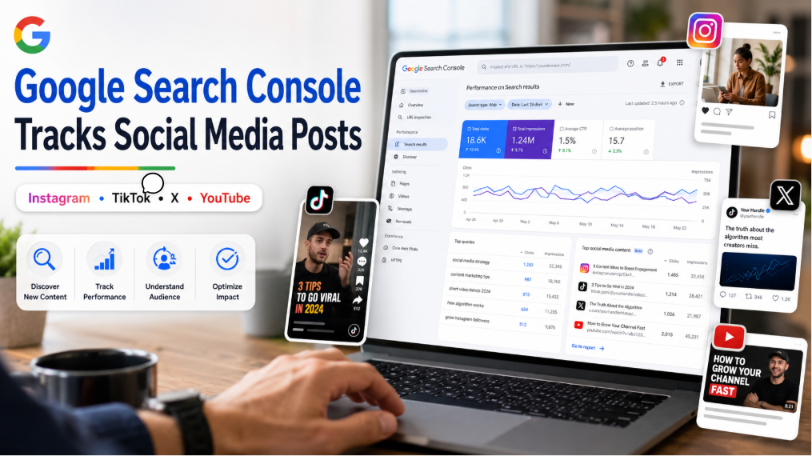
Google Search Console platform properties let creators track how Instagram, TikTok, X, and YouTube content performs on Google. Reports include clicks, impressions, queries, CTR, and average position but do not replace native social analytics.
News Summary:
Google Search Console can now track content from Instagram, TikTok, X, and YouTube.
The reports display clicks, impressions, search queries, click-through rate, and average position.
Creators can add each account or channel as a separate Search Console property.
The reports measure visibility on Google, not views or engagement inside the social platform.
The feature is rolling out gradually and may not appear in every account yet.
Google Search Console is no longer only for websites.
On July 7, 2026, Google announced platform properties, a new type of Search Console property for Instagram, TikTok, X, and YouTube accounts. The update lets creators and publishers see how their posts perform when people find them through Google Search. Some eligible content can also receive separate reporting for Google Discover and Google News.
What Did Google Add to Search Console?
The platform property connects a social account or video channel to Google Search Console.
Once you verify the account, Search Console shows the Google searches that brought people to its posts. It can also tell you which posts had the most clicks or impressions from Google.
The first supported platforms are:
Instagram
TikTok
X
YouTube
Each account must be added as its own property. A creator with two Instagram profiles and one YouTube channel would need to set up three separate platform properties.
This builds on an experiment Google introduced in December 2025. That earlier test added some social-channel data to Search Console Insights for website owners. The new system gives social accounts their own properties and can also work for creators who do not have a website.
What Data Will Platform Properties Show?
The main performance report includes the following:
Total clicks
Total impressions
Average click-through rate
Average search position
Search queries
Individual posts that received traffic
Users can filter and sort the data to identify the posts and queries generating the most Google traffic. Google also allows the information to be exported for further analysis.
The Insights report provides a simpler overview of recent traffic, top-performing posts, and the ways people find an account through Google.
There is also an Achievements section. This records milestones such as reaching a new click total during a 28-day period.
The default reporting period is 28 days. New properties may show empty charts at first because Google says it can take several days to collect and process the data. Reporting begins after the property is connected, so users should not expect a complete history from before setup.
Can It Track Google Discover and Google News?
Google says the performance report can include traffic from Search, Discover, and Google News.
But Discover and News reports will only appear when the connected account has received traffic from those surfaces. A creator who has never appeared in Discover will see a non-empty Discover report in the menu.
There is also a reporting detail that may confuse users.
The main insights summary can include clicks from web, image, video, and news searches. However, some of the detailed cards below the main insights summary focus solely on regular web searches. This means the smaller cards may not add up to the total shown at the top.
How to Add an Instagram, TikTok, X, or YouTube Property
Google gives the following setup process:
Open Google Search Console.
Open the property selector.
Select Add property.
Choose Instagram, TikTok, X, or YouTube.
Follow the authorization steps.
Wait a few days for the first reports to appear.
Verification may happen through a direct platform login or through an automated connection with an existing website property. Google will also verify ownership from time to time. If the connection expires or access changes, reporting can pause until the account is verified again.
Adding a property does not improve rankings by itself. It only provides access to performance information.
What Platform Properties Do Not Track
This is the most important limitation.
Platform properties do not replace Instagram Insights, TikTok Analytics, X Analytics, or YouTube Studio. They only show what happens when the account’s content appears on Google.
For example, Search Console will not show the following:
How many times a TikTok video appeared in TikTok’s feed
How many Instagram followers viewed a story inside Instagram?
Native likes, comments, saves, or shares
Revenue generated inside YouTube
Reach produced by a platform’s recommendation algorithm
Google does explain how some unusual interactions are counted.
An Instagram Story receives an impression when it appears in Google Search. It receives a click when someone selects it. A video can also receive a Search Console click when it opens inside Google’s own video viewer rather than sending the person directly to YouTube or another platform. (Google Help)
Technical warning: Do not combine Search Console clicks with native platform views and label the total “content reach.” They measure different actions and may include overlapping users.
Why This Matters for Creators
Creators have often had to guess whether Google sends meaningful traffic to their social posts.
A YouTube video might rank for a tutorial query. An Instagram post might appear when someone searches for a product, place, or person. A TikTok video may surface for a how-to question.
Platform properties make more of that behavior visible.
This feature is especially useful for creators who do not own a website. Search Console was traditionally built around verified web properties. Google is now giving social-first publishers access to parts of the same search-performance data. Independent reports from Search Engine Journal and The Verge also highlighted this expansion beyond conventional site owners.
But creators should not treat this expansion as a reason to avoid building an owned platform.
A social account is still controlled by another company. Its reach, rules, and monetization options can change. Search Console data should help creators identify demand they can turn into website articles, email newsletters, products, and landing pages they control.
Marketers should utilize the new query data effectively.
The useful part is not simply seeing more numbers.
The real opportunity is finding search demand that has already been proven by social content.
Use this workflow:
Export the queries that produce impressions and clicks.
Separate branded searches from non-branded searches.
Group the queries by informational, comparison, and buying intent.
Identify social posts that rank where your website does not.
Turn the strongest topics into detailed owned content.
Link the article, video, and social post together where it helps the reader.
Review the results after 28 days.
Suppose a short YouTube video receives Google impressions for “how to measure YouTube brand demand.” That may justify creating a longer guide, newsletter, or service page.
OnlineCOSMOS has already covered Google’s new metrics for YouTube brand campaigns, including how advertisers can compare YouTube exposure with later branded searches. Platform properties provide another piece of that measurement process by showing which social and video posts gain visibility in organic Google results.
How Publishers Should Avoid Bad Decisions
Do not rewrite your whole content plan after seeing one high-impression post.
First check:
Does the query match the content?
Did it receive clicks or only impressions?
Is its average position improving?
Does the topic connect to your products or expertise?
Could you provide additional insights that enhance the value of the social post?
Is the traffic likely to continue, or was it tied to short-lived news?
Search Console is evidence, not an automatic instruction.
Publishers should also examine traffic changes alongside Google updates. OnlineCOSMOS’s report on the Google June 2026 spam update explains why changes in clicks and impressions should be reviewed at the query and page level instead of being blamed on one update without proof.
What Is Still Unclear?
Google is rolling out platform properties over several weeks, so some users may not see the option immediately.
The launch currently supports only four platforms. Google has not announced support for Facebook, LinkedIn, Pinterest, Threads, Reddit, or other creator platforms.
It is also too early to determine the amount of useful query data that smaller accounts will receive. Search Console can limit or hide low-volume information for privacy and processing reasons, so the value may differ widely between accounts.
Here are the next steps for creators and marketers.
Open Search Console and review the property selector.
Add every eligible account you control. Then let the reports collect data for at least several days before making decisions.
After the first complete 28-day period, compare:
Your top social posts in Google
Your top website pages
Queries shared by both
Queries where social content ranks but your website does not
Topics with clear commercial or newsletter potential
The goal is not to move every social post onto your website.
The goal is to find proven audience questions and build stronger content around the ones that matter to your business.