

News Overview:
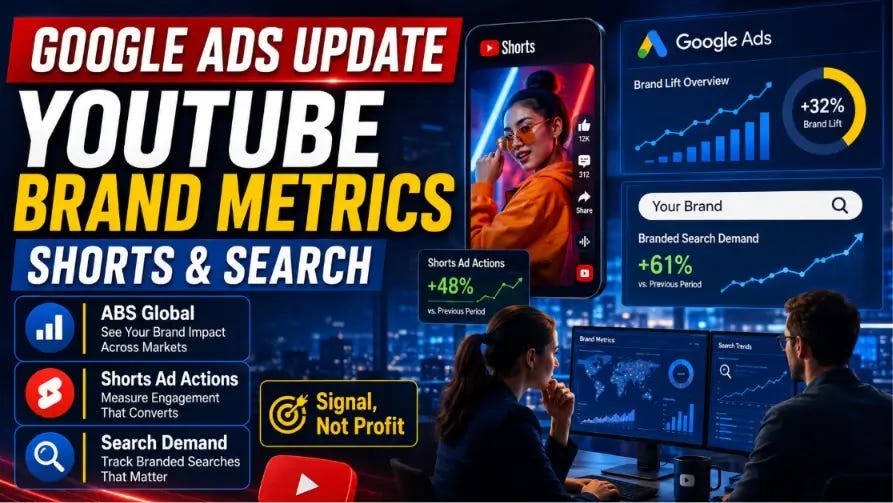
Google has added new YouTube brand campaign measurement signals. Video View Campaigns opted into Shorts now include Shorts Ad Actions in optimization and reporting, while Attributed Branded Searches is globally available to help advertisers connect YouTube ad exposure to later branded search behavior.
YouTube Views Are Not Enough Anymore
Google knows the old brand-ad report is weak.
Views, impressions, and reach help you prove delivery. They don’t prove demand. So Google is adding more signals to help advertisers connect YouTube campaigns to user behavior after the ad runs.
For you, the real question is simple: did the video make people search for the brand later?
What Did Google Change?
Google announced two main updates for YouTube brand campaigns.
First, Video View Campaigns that are opted into Shorts will now automatically include Shorts Ad Actions in budget optimization and new reporting columns. Google also says Shorts ads with more than 10 seconds of watch time and a like saw higher brand consideration and favorability in its internal data.
Second, Attributed Branded Searches is now globally available as a Google Ads reporting metric. Google says the metric tracks searches triggered by an ad impression or view.
What Are Shorts Ad Actions?
Shorts Ad Actions are engagement signals from ads shown in YouTube Shorts.
The important detail is that Shorts doesn’t behave like standard in-stream YouTube ads. Google says Shorts public views can count when playback starts, while engagements and engaged-view conversion rules depend on the ad format and user action.
So don’t blend Shorts and in-stream performance into one lazy chart. You’ll hide the actual behavior.
Shorts Metrics Can Distort Your Report
Shorts is a swipe-feed format.
That means a “view,” “engagement,” or “conversion assist” can carry a different meaning than the same-looking metric from in-stream video. Google’s own help documentation separates Shorts rules from other formats, including how Shorts public views and engaged-view conversions are counted.
If you report everything as “YouTube video performance,” you’re asking for bad decisions.
What Are Attributed Branded Searches?
Attributed Branded Searches, or ABS, measures branded searches after someone sees a YouTube ad.
Google describes ABS as an always-on metric that connects a video campaign to later branded search activity. It only counts users who saw a YouTube ad, so it’s a subset of total branded searches, not your full brand search volume.
That distinction matters. ABS helps show demand creation, but it doesn’t tell you the whole revenue story.
Google Is Closing the YouTube-to-Search Loop
Think of this as a leaky pipe getting patched.
Before, YouTube could create interest, but the reporting often stopped at reach, views, or engagement. Now Google is trying to show whether that interest moves into branded search behavior.
That’s useful for agencies. It gives you a stronger way to defend brand spend when a client only wants last-click conversions.
ABS Still Doesn’t Prove Profit
Don’t oversell this metric.
ABS can help show that people searched after seeing an ad. It does not prove that YouTube alone caused the sale, beat another channel, or generated incremental revenue. Google positions ABS as a lead indicator that complements incrementality experiments, not as a replacement for them.
So use it as a signal. Don’t use it as the scoreboard.
What Should Advertisers Do Inside Google Ads?
Start by checking whether Attributed Branded Searches are available in your account.
Google says advertisers should contact their Google representative to activate ABS. Google’s ABS page also points to 2026 improvements around self-service brand mapping and segmentation of new searchers, so check whether those controls are visible in your account before reporting results to a client.
Then add ABS to your reporting view and segment YouTube results by format. Keep Shorts, in-stream, in-feed, and connected TV separate when you brief a client.
Why This Matters for Agencies
This helps you defend upper-funnel spend.
A YouTube campaign may not convert immediately. But it can create brand recall, push users into Google Search, and support later conversion paths. Google’s engaged-view conversion documentation makes the same basic point: video users often act after the viewing session, not during it.
But your dashboard needs discipline. If the number of people searching for a brand goes up we need to see if something else was happening at the time. This could be a press release, an email, a post from someone who’s famous, a discount or an advertisement that the company paid for.
Why This Matters for People Who Make Things and Company Owners
This update may make YouTube brand campaigns easier to sell.
If companies that make ads can prove that people who see their ads on YouTube are more likely to search for their brand they might be more willing to give money to people who make videos to help them make videos, sponsored videos and videos that help people know about their brand.
Google already helps ads for videos work with many types of campaigns like Video View, Video Reach, Demand Gen, Performance Max and App campaigns. This means people who make ads can use YouTube to reach their goals. YouTube exposure and branded search are important for people who make ads on YouTube. This is why YouTube exposure and branded search matter for them.
But creative quality still does the heavy lifting. A metric can’t fix weak positioning, poor hooks, or a brand name nobody remembers.
Checklist Before You Report ABS
Use this before you send a client update:
Separate Shorts from in-stream, in-feed, and CTV.
Confirm ABS is active in the account.
Map brand terms clearly.
Compare ABS movement against campaign launch dates.
Check whether branded search traffic is also lifted in Search Console or analytics.
Look for outside noise: PR, discounts, influencer posts, email launches, or seasonality.
Don’t call ABS “revenue” unless sales and incrementality data support it.
This keeps the report honest.
What’s the Real Business Impact?
Google is making YouTube brand ads easier to justify.
That’s good for agencies that struggle to defend spending on awareness. It’s good for brands that want to prove search demand after video exposure. And it’s good for Google because it ties YouTube more tightly to Google Ads reporting and Search behavior.
But the burden is still on you. If you report ABS without context, you’ll turn a useful signal into another vanity metric.
So What Should Advertisers Do Next?
Update your YouTube reporting dashboard this week.
Add Attributed Branded Searches if your account has access. Split Shorts from other YouTube formats. Then rewrite your client reporting around one sharper question:
Did this campaign create measurable brand search demand?