

News Overview:
Google completed its June 2026 spam update on June 26 after a two-day rollout that applied globally and across all languages. Webmasters should review Search Console data after the rollout window and check pages for spam risks such as thin affiliate content, doorway pages, keyword stuffing, user-generated spam, and attempts to manipulate AI Search.
Google says the June 2026 spam update began on June 24, 2026.
The rollout completed on June 26, 2026, according to the Google Search Status Dashboard.Google stated the upgrade applied worldwide and to all languages.
Website owners need to examine whether traffic changed after the rollout window, not before it.
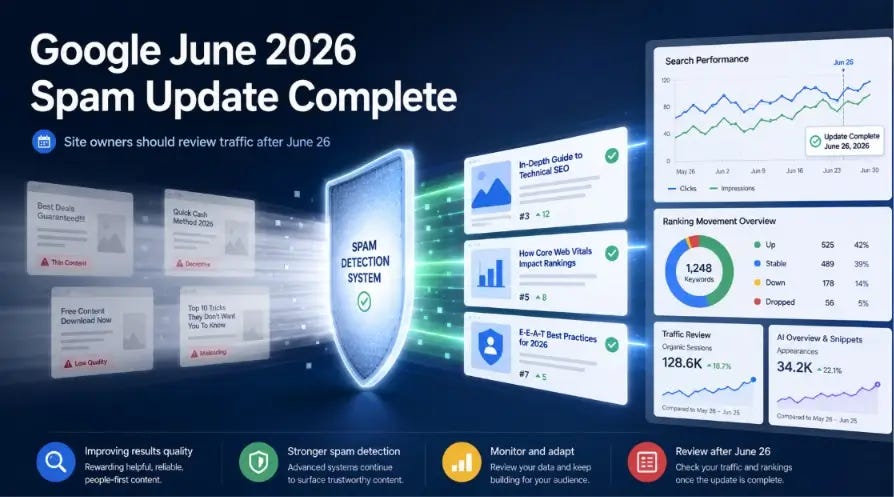
Google has finished rolling out its June 2026 spam update.
The company’s Search Status Dashboard says the upgrade started on June 24, 2026, and was complete since June 26, 2026. (Source: Google Search Status Dashboard).
What Google Confirmed.
Google stated the June 2026 spam upgrade applied globally and to all languages.
That indicates it was not restricted to one nation, one language, or one kind of site.
The upgrade affected Google Search ranking systems. Ranking systems are the systems Google utilizes to choose which pages appear higher or lower in search engine result.
The Rollout Took Two Days
The update began at 9:00 a.m. Pacific Time on June 24 and ended at 10:00 a.m. Pacific Time on June 26. Search Engine Land reported that the upgrade took about 2 full days to present.
That brief window matters. If a website lost or acquired traffic around those dates, the spam update may be one possible reason.
However it is not the only possible reason.
What a Spam Update Means?
A Google spam algorithm update is used to reduce content or techniques that break Google’s spam rules.
Google states spam includes tactics used to deceive users or manipulate Search systems. Manipulating means trying to unfairly control or trick the system.
Google also says spam can include attempts to control generative AI responses in Google Search. Generative AI responses are AI-written answers displayed in Search features such as AI Overviews or AI Mode.
What Google Counts as Spam
Google’s spam policies cover numerous kinds of bad or risky behavior.
These consist of masking, doorway abuse, hidden text, keyword stuffing, thin affiliate pages, user-generated spam, fraud content, low quality content, and policy circumvention.
Cloaking means revealing one thing to Google and another thing to users.
Doorway abuse means making lots of comparable pages just to rank for search terms and push users to another website.
Keyword stuffing means adding a lot of keywords in an abnormal method to try to rank greater.
Thin affiliate pages are pages that use affiliate links but add little or no original value.
The AI Search Angle Is Important
This update lands at a time when Google is warning against attempts to manipulate AI answers in Search.
Google’s current spam policy says spam can consist of attempts to control generative AI responses in Google Search.
The Verge reported that this language impacts techniques focused on AI Overviews and AI Mode, including efforts to make AI systems prefer particular sites or brands.
For publishers, this is necessary. The danger is no longer just old-style SEO spam. It can likewise include content made to fool AI search responses.
Who Should Pay Attention First
Affiliate websites need to pay very close attention.
Google says thin affiliate pages can be an issue when they use copied or repeated content without adding helpful value.
A great affiliate page must include something genuine. That can include original reviews, clear product comparisons, testing notes, helpful details, or much better navigation.
Sites that release lots of similar reviews, coupon pages, or “best” lists should check whether those pages give readers enough original help.
What Site Owners Should Check Now
Site owners should compare traffic before and after the rollout window.
The cleanest window is before June 24, 2026, and after June 26, 2026.
They should examine Google Search Console for changes in clicks, impressions, top queries, and top pages. Search Console is Google’s free tool that demonstrates how a site performs in Search.
Do Not Assume Every Drop Is a Penalty
A traffic drop after June 26 does not always suggest Google punished a site.
It might come from seasonality, tracking problems, technical problems, search layout changes, stronger competitors, or changes in AI answers.
Editors and SEO teams should avoid panic modifications. Initially, they should find which pages dropped, which queries changed, and whether the impacted pages match any spam-risk pattern.
The Pages Most at Risk
The pages that made for online search engine instead of people must review their website.
That consists of copied pages, mass-produced pages, doorway pages, pages filled with repeated keywords, and affiliate pages with little or no original value.
Websites must also examine user-generated areas, such as comments, forums, profile pages, and upload sections. Google lists user-generated spam content as a spam risk. Webmasters should aware of this.
What Publishers Should Fix First
Publishers should begin with pages that lost the most Search traffic.
They should ask easy questions like:.
Does this page helpful and useful a genuine user?
Is the content original and valuable?
Does the page clearly reveal who made it?
Does it use copied text from merchants or other web sites?
Does it promise more than it proves?
Does it exist only to rank for a keyword?
If the response is weak, the page needs editing with useful value, merging with another posts, doing Noindexing, or completely remove the page.
Noindexing means informing online search engine not to show the page in search engine result.
What Affiliate and Review Sites Should Change
Affiliate and reviews websites should add proof.
That includes original screenshots, first-hand notes, test results, prices checks, product comparison tables, and clear advantages and disadvantages.
Google states good affiliate pages can include value through original reviews, testing, ratings, navigation help, and comparisons.
A page that only repeats product descriptions is easier to replace. A page with genuine testing is more difficult to neglect.
What Google Has Not Said
Google has not stated which exact spam systems changed in this upgrade.
Google has also not released a list of affected websites.
That means no one outside Google can truthfully state a site was hit by this update without examining the site’s data.
SEO teams need to take care with claims like “the spam update caused this” unless the timing and page-level data support it.