

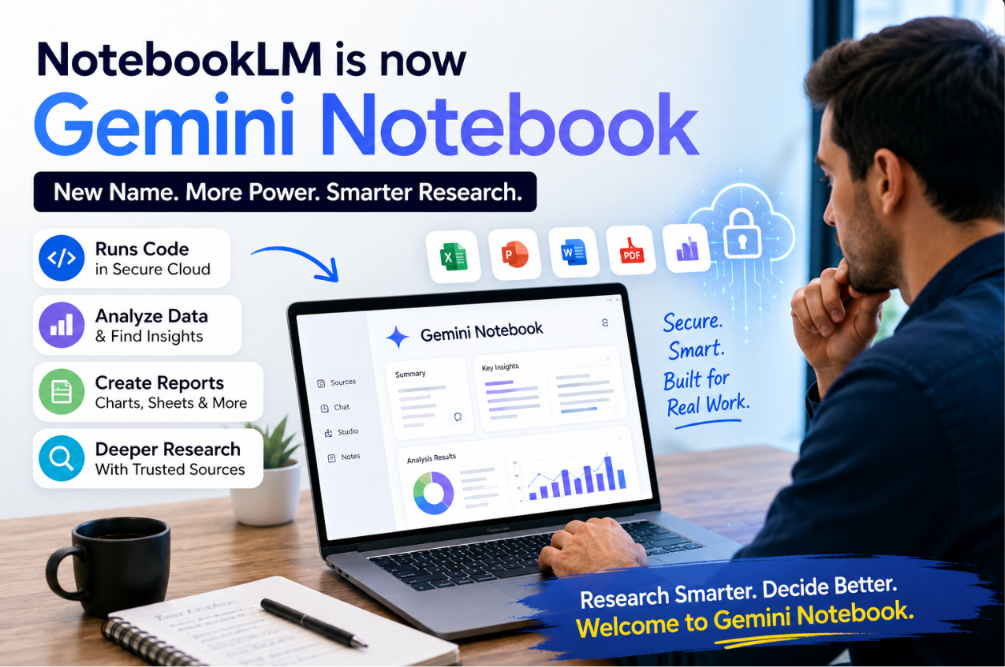
Google has renamed NotebookLM to Gemini Notebook, but it’s still a separate research project. Key results still need human validation, but eligible users can use secure code execution, more granular data analysis, and more downloadable output formats.
News Summary:
NotebookLM is now called Gemini Notebook.
It remains a separate product rather than becoming only a Gemini app feature.
Selected paid users can let it write and execute code in a secure cloud environment.
Google plans to make notebooks available inside AI Mode in Search.
Google has changed the name of one of its best-known AI research tools.
But the change is more than a branding update.
NotebookLM is becoming Gemini Notebook while gaining tools that move it closer to a full research and analysis workspace. Google says the product can now use a secure cloud computer to write and run code based on the sources in the notebook.
Is NotebookLM being shut down?
No.
Google says Gemini Notebook remains a standalone product focused on research. Existing notebooks will continue to work, while users will also be able to access synced notebooks through the Gemini app.
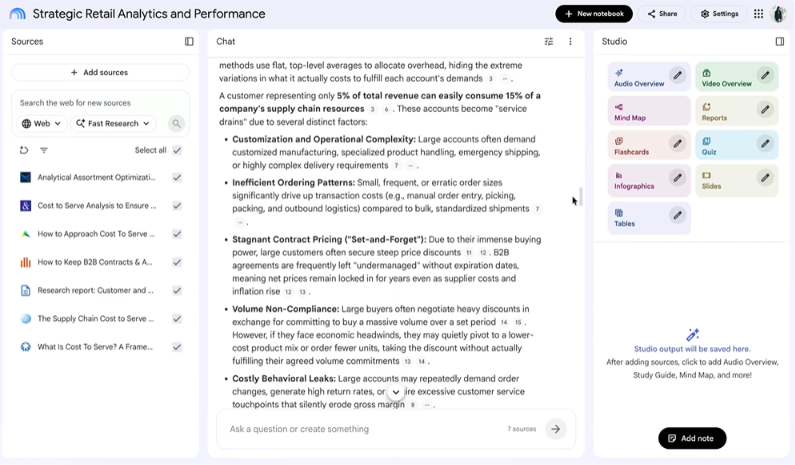
The new name signals that the product is becoming more closely connected to Google’s wider Gemini system.
Google also plans to bring notebooks into AI Mode in Search, although the company has not announced a firm public launch date for that integration.
What Can Gemini Notebook Do With Code?
Each supported notebook can connect to a secure cloud computer. This lets the system create and run code for tasks like cleaning data, comparing figures, finding patterns, and producing charts.
For example, a marketer could upload campaign reports from several countries. Gemini Notebook could help standardize the files, calculate results, and prepare a chart or written report.
Google says the system includes more than 100 curated software skills and can create downloadable files such as the following:
Excel spreadsheets
PowerPoint presentations
PDF and Word documents
Charts and images
CSV and JSON data
That makes Gemini Notebook more useful for business research, not just summarizing PDFs or producing audio discussions.
Who Gets the New Features?
The code-execution upgrade is available first to Google AI Ultra users and certain Workspace business customers with eligible AI access.
Google says it will reach Pro users on the web over the following weeks. Availability may therefore depend on the user’s plan, account type, and rollout status.
Consequently, the rename may appear before every account receives the more advanced tools.
Can the Gemini Notebook replace a research team?
Not yet.
Google says the upgraded system performed better than its previous version in internal tests. It reported a 78.2% win rate against its earlier baseline for advanced web research and source discovery.
But that is a first-party comparison. It does not prove that Gemini Notebook is more accurate than ChatGPT, Claude, Perplexity, or a skilled human analyst.
And running code correctly is not the same as choosing the right analysis.
A system can calculate the wrong metric perfectly. It can also produce a polished spreadsheet based on incomplete data or a weak assumption.
Technical note: Grounding the source reduces some errors but does not guarantee that generated code, calculations, or conclusions are correct.
Users should still check formulas, source data, and important business conclusions before publishing or acting on them.
Why This Technical Warning Matters for Marketers and Founders
For agencies, Gemini Notebook could combine several steps that often require separate tools:
Gather sources
Add campaign or sales data
Run an analysis
Create charts
Produce a report or presentation
Creators and coaches may use it to turn research into teaching materials, worksheets, or client reports.
SaaS founders can use it for competitor research, client feedback analysis, and internal planning.
But affiliate publishers should be careful. Gemini Notebook can help organize public information, yet it cannot replace actual product testing. A generated comparison is not evidence that the writer used the software.
What should you test before relying on it?
Use one real but non-sensitive research project.
Upload trusted sources and a small dataset. Ask Gemini Notebook to calculate known figures, explain its method, and create a downloadable report.
Then verify:
Every important citation
Every formula
Every numerical result
Every claim not directly found in a source
Every recommendation based on assumptions
The test will show whether the tool saves real time or simply creates more work to verify.
What Happens Next?
Google says Gemini Notebook: Well over 30 million people and more than 600,000 organizations use Gemini Notebook, according to Google. More than 30 million people and 600,000 organizations use Google Gemini Notebook, according to the company. These figures, provided by Google, have not undergone independent auditing and were included in the announcement. in the announcement.
The larger strategic change is integration.
NotebookLM began as a focused research product. Gemini Notebook is becoming a research layer that can move across the standalone app, Gemini, and eventually Google Search.
That could make it more convenient. It could also make users more dependent on Google’s AI ecosystem.
Gemini Notebook is still NotebookLM at its core. Your notebooks remain, and the product continues to focus on source-based research.
But the addition of code execution, business-file creation, and wider Google integration makes it a more serious analysis tool.
The practical next step is simple: test it against a task where you already know the correct answer. That will tell you more than Google’s benchmark numbers.