

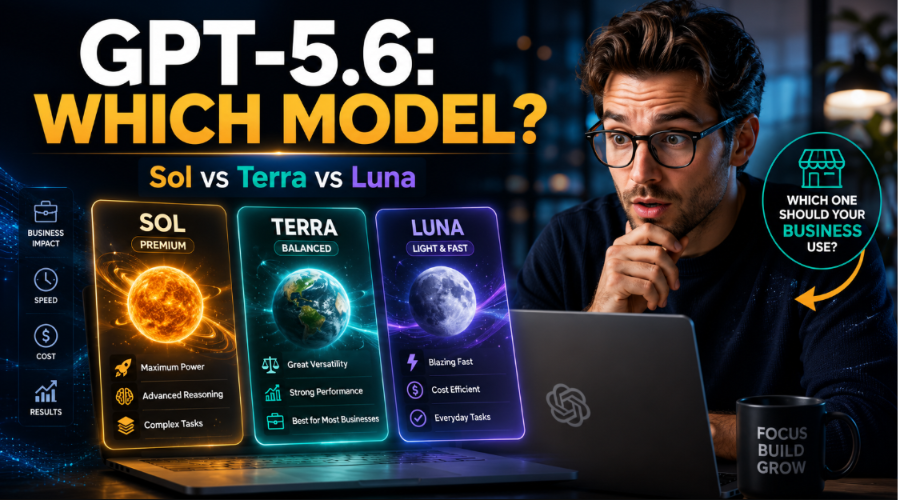
OpenAI’s GPT-5.6 family includes Sol, Terra, and Luna, giving users different choices for capability, speed, and cost. Small businesses should use Luna for low-risk repetitive tasks, Terra for everyday business work, and Sol for complex, high-value workflows.
The real question for businesses is not which model is “best.” It is the model that is worth paying for.
News Summary:
OpenAI says GPT-5.6 is now available across ChatGPT, Codex, and the OpenAI API.
The model family has three main tiers: Sol, Terra, and Luna.
Sol is the flagship model. Terra is the balanced option. Luna is the fastest and cheapest option.
Luna API pricing starts at $1 per 1 million input tokens, and Sol API pricing goes up to $5 per 1 million input tokens.
Rather than always using the most powerful model for every situation, businesses should choose the model that best suits the task at hand.
OpenAI Releases GPT-5.6 With Three Model Tiers
OpenAI has released the GPT-5.6 model family for broader use, with three main versions: Sol, Terra, and Luna. The company describes Sol as its flagship model, Terra as a lower-cost model for everyday work, and Luna as its fastest and most affordable model.
The rollout matters because OpenAI is no longer selling one simple idea of “the best model.” It is pushing users toward model selection based on cost, speed, and task difficulty.
That is a practical shift for marketers, creators, agencies, SaaS founders, affiliate operators, and small teams. If you use AI for research, writing, coding, spreadsheets, landing pages, support replies, product analysis, or automation, the wrong model choice can quietly raise your costs.
What Is GPT-5.6 Sol?
GPT-5.6 Sol is the highest-capability model in the GPT-5.6 family.
OpenAI says Sol is designed for demanding work, including professional analysis, complex coding, computer use, long-running workflows, cybersecurity tasks, design work, presentations, documents, and spreadsheets. The company says Sol reached 90.4% on BrowseComp and 62.6% on OSWorld 2.0, two tests related to browsing and computer-use tasks.
For a small business, Sol is the model to consider when the task is complex and errors are expensive.
That could include:
Financial analysis
Legal-style document review
Complex spreadsheet building
Technical debugging
Multi-step market research
Building a polished slide deck
Reviewing a messy business workflow
Creating or testing code
But Sol is also the most expensive GPT-5.6 tier in the API. OpenAI lists Sol at $5 per 1 million input tokens and $30 per 1 million output tokens.
So Sol should not be the default model for every small task.
What Is GPT-5.6 Terra?
GPT-5.6 Terra is the middle option.
OpenAI describes Terra as a lower-cost model with performance competitive with GPT-5.5. It is meant for everyday work where users still need strong quality but may not need the full cost of Sol.
For most content and marketing teams, Terra may become the practical default.
Use Terra for:
Blog outline generation
First-draft newsletters
SEO briefs
Email sequences
Product descriptions
Social post variations
Basic customer-support drafts
Research summaries
Landing-page structure
Competitor note-taking
Terra costs $2.50 per 1 million input tokens and $15 per 1 million output tokens through the API, according to OpenAI.
That price difference matters. If an agency is producing hundreds of drafts, briefs, summaries, and internal documents every week, Terra may deliver enough quality without paying Sol-level rates for every pass.
What Is GPT-5.6 Luna?
GPT-5.6 Luna is OpenAI’s fastest and most affordable GPT-5.6 model.
OpenAI positions Luna as the low-cost tier for high-volume or lighter tasks. It is priced at $1 per 1 million input tokens and $6 per 1 million output tokens through the API.
Luna is not the model you would choose for a critical legal memo, a difficult coding issue, or a high-stakes financial model.
But it may be the right choice for tasks such as tagging content or cleaning short text.
Tagging content
Cleaning short text
Summarizing simple notes
Rewriting headlines
Creating quick social captions
Classifying support tickets
Drafting simple replies
Formatting content
Generating product-title variations
Running low-risk automation steps
For affiliates and e-commerce operators, Luna could be useful for repetitive content operations. Think product data cleanup, meta descriptions, category text, search-query grouping, or review-summary extraction.
GPT-5.6 Pricing: The Simple Business View
Here is the practical pricing difference from OpenAI’s API rates:
Model Best Use: GPT-5.6 is ideal for challenging, high-value work. GPT-5.6 Sol costs $5 per 1 million tokens for input and $30 per 1 million tokens for output. GPT-5.6 Terra has a cost of $15 per million tokens and $2.5 per million tokens. LunaFast offers low-cost tasks at a rate of 1 token per 1 million tokens for input and 6 tokens per 1 million tokens for output.
The cost gap is not small.
Sol output costs five times more than Luna output. That does not mean Luna is “better value” for every task. It means teams need a routing strategy.
A useful rule: start with the cheapest model that can reliably complete the task, then upgrade only when the risk or complexity justifies it.
What Should Creators and Marketers Use?
Creators and marketers should not automatically use Sol for every piece of content.
If you just need to plan basic content, write social media captions and email subject lines and repurpose content, Luna or Terra may be enough. If you want more in-depth product comparisons, editorial analysis, paid campaign strategy, or stronger newsletter essays, Terra is probably the best place to start.
Use Sol when the work needs deeper reasoning, sharper judgment, or several steps of analysis.
For example, if you are writing a detailed software comparison, use Terra for the first structure and Sol for the final editorial review. When turning social-search data into an owned content plan, you could start with Terra and then use Sol for the strategic layer.
OnlineCOSMOS has already covered how creators can use Google Search Console to track social content on Google Search. That kind of query data becomes more useful when paired with the right AI model for research, clustering, and content planning.
What Should Agencies and SaaS Teams Use?
Agencies and SaaS teams should think in workflows, not prompts.
A smart workflow may use all three models:
Luna for sorting, tagging, formatting, and simple summaries.
Terra for drafting briefs, emails, documentation, and support replies.
We have successfully sorted the final strategy, complex analysis, coding, and client-facing deliverables.
The software stops teams from wasting money on routine tasks but keeps quality high where it matters.
It also creates a cleaner review process. Junior work can be run through Luna or Terra. Senior-level judgment can be reserved for Sol and human review.
The Big Warning: Benchmarks Are Not Your Workflow
OpenAI reports strong results for GPT-5.6 across coding, professional work, computer use, cybersecurity, academic tasks, and multimodal tests. But those are still vendor-reported results unless repeated by independent testers.
That matters.
A benchmark can show model strength, but it does not prove the model will perform well in your exact business process.
Axios also noted that the independent review of GPT-5.6 was still limited during the early public rollout, with much of the early excitement coming from early testers and OpenAI-linked discussions.
So don’t buy the model story. Test the workflow.
What Is Still Unclear?
A few important questions remain.
We do not yet know how GPT-5.6 will perform across a wide range of small-business tasks once more independent users test it. We also do not know how many companies will actually save money after adding model routing, prompt caching, agent workflows, and human review.
Reuters reported that OpenAI’s broader GPT-5.6 launch followed a limited-access period connected to U.S. government concerns about national security risks from powerful AI models.
That background is important, but it does not change the practical question for most businesses: how do you use the right model without wasting money or increasing risk?
GPT-5.6 is not one model decision. It is a model-routing decision.
For small businesses, the simplest starting point is this:
Use Luna for cheap, repeatable, low-risk work.
Use Terra for everyday marketing, content, support, and research.
Use Sol for complex, high-value work where mistakes cost more than the model.
The best AI setup will not be the one that always uses the strongest model.
It will be the one that uses the right model at the right step, with human review where judgment still matters.