

Google Business Profiles are losing a ton of visible customer reviews. Google says suspicious-review systems can remove or pause reviews, but it is investigating and plans to restore reviews removed by mistake.
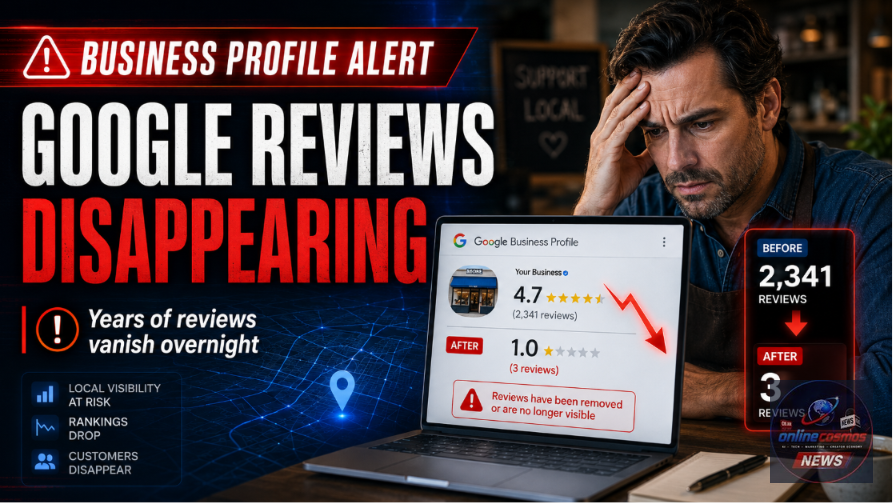
Imagine opening Google Maps and finding that the customer reviews you spent years earning are gone.
You may find your five-star rating missing. Your review count may drop to zero. New reviews may stop appearing.
That is what some business owners reported in early July. Google has acknowledged the issue and says it will restore reviews that were removed by mistake, but the company has not given a public recovery date.
Insights Summary:
Some Google Business Profiles have lost hundreds or thousands of visible reviews.
Google says suspicious-review detection can remove reviews or temporarily pause new ones.
The company is investigating whether legitimate reviews were removed incorrectly.
There is no confirmed timeline for restoring affected reviews.
Business owners should document the loss before changing their profiles.
1. Some businesses saw years of reviews disappear overnight.
The reports are not limited to one company or industry.
Business owners began posting complaints in the Google Business Profile Help Community, saying large parts of their review history had vanished. One reported profile dropped from about 4,651 reviews to 63. Another said more than 1,200 reviews disappeared, and the profile showed no rating.
Some businesses also reported that new reviews were no longer appearing.
The scale appears to vary. Some profiles lost a smaller number, while others lost nearly every visible review. Google has not said how many businesses are affected.
2. Google says its anti-spam systems may be involved.
Google told Search Engine Roundtable that its systems take action when they find suspicious reviews.

Those actions may include removing reviews and temporarily stopping new reviews from appearing on a profile. Google said the pause aims to prevent further abuse while its systems examine the activity.
“We are investigating the issue and will restore any reviews that were incorrectly removed.”
— Google spokesperson (Search Engine Roundtable)
That wording is important.
Google is not saying that every missing review will return. Reviews that truly break its rules may remain removed. But legitimate reviews caught by mistake could be restored.
Google’s own help pages admit that automated spam detection can sometimes remove genuine customer reviews incorrectly. Businesses are told to contact support when that happens.
3. A fake-review attack may trigger a wider review block.
Several affected businesses said their problems began after their profiles received waves of fake or suspicious reviews.
In some cases, owners reported the fake reviews. Soon after, their legitimate reviews also disappeared or new reviews stopped appearing.
That does not prove that reporting spam caused the loss.
A more likely explanation is that Google’s system detected an unusual review pattern and placed a wider restriction on the profile while it checked the activity. But Google has not publicly confirmed the exact trigger for each affected account.
Its review policy says it may treat unusual volumes or patterns as possible rating manipulation. Google can also temporarily unpublish existing reviews or stop a profile from receiving new ones when it believes fake engagement has occurred.
4. Not every missing review is part of the same incident.
A review can disappear for several normal reasons.
Google says reviews may be delayed while they are checked for policy violations. Reviews can also take time to appear after two business profiles are merged. In some cases, Google temporarily disables user-created content for certain profiles or business categories.
That means owners should first identify the pattern.
A single new review that has not appeared for two days is different from 1,000 reviews disappearing at once.
A sudden, large drop—especially when the rating also falls to zero—is more likely to require support attention than a short delay affecting one customer review.
5. Lost reviews can hurt trust before they hurt rankings.
Review count isn’t just a number.
Often customers use ratings and recent feedback to decide on whether to call, book, visit, or buy. A business that suddenly drops from thousands of reviews to only a few may look new, unpopular, or untrusted—even when nothing about its service has changed.
Reviews may also affect local search visibility. Google says local results are mainly based on relevance, distance, and prominence. Review quantity and positive ratings can contribute to a business’s prominence in local results.
But owners should not assume that missing reviews cause every ranking change.
Local results change for many reasons. The clearest immediate risk is that people who still see the profile will lose customer confidence and lower conversion rates.
This case also shows why businesses should not depend on one platform for all their public proof. Customer stories, testimonials, and case studies should also live on the company’s own website.
OnlineCOSMOS has previously covered how Google’s automated systems can create sudden changes for publishers and businesses, including the Google June 2026 spam update.
6. Document the damage before changing anything.
When reviews disappear, the first thing to do is not panic but document.
Save the following:
A screenshot of the current review count and rating.
If possible, an older screenshot with the previous count.
Date and approximate time changes came up.
Business profile name, address & profile URL.
Your Google support case number.
Links or screenshots from customers whose reviews disappeared.
Details on any recent fake review attack or spam reporting activity.
Recent changes to the profile, such as a merge, reinstatement, or category edit, are also important.
This record provides Google support with a clearer timeline.
It helps agencies explain the issue to clients as well, without having to rely on memory or partial reports.
7. Do not rebuild the profile or flood it with replacement reviews.
A missing-review incident can make drastic action feel tempting.
Do not create a duplicate business profile to replace the affected one. Do not delete the existing profile. And don’t change the business name, address, or main category unless the information is wrong.
Those changes can create new verification or duplication problems while the review issue is still under investigation.
It is also risky to ask a large group of customers to repost reviews at the same time. Google’s policy treats unusual review volumes and patterns as possible rating manipulation.
A safer approach is to preserve your normal review-request process and wait for clearer guidance before launching a large replacement campaign.
Expert warning: Do not offer discounts, gifts, or payment in exchange for new reviews. Google treats rewarded reviews as fake engagement, even when the customer is real.
8. Use the correct recovery path for the problem you experience.
There are two main routes.
If reviews appear to have vanished because of a technical mistake, use Google Business Profile support and provide the evidence you collected. Google’s help page specifically says businesses should contact support when automated detection removes legitimate reviews.
If Google has sent an email saying your profile received a policy restriction, use the appeal process included in that notice. Google says businesses can appeal restrictions and provide extra context for another review.
Do not report every negative review simply because you dislike it.
Google says reviews are only eligible for removal when they break its policies. A normal complaint from a real customer is not automatically a policy violation.
9. Agencies should tell clients what is known—and what is not.
Local SEO agencies may feel pressure to promise a fast solution
That would be a mistake.
The confirmed facts are limited: Google knows about the issue, suspicious review systems may be involved, the company is investigating, and reviews removed by mistake are expected to return. No public restoration date has been announced.
A clear client message would say:
We have documented the review loss and opened the correct support path. Google has acknowledged a broader issue, but it has not provided a recovery timeline. We are monitoring the profile and avoiding unnecessary edits that could create new problems.
That is more useful than pretending an agency can force Google to restore reviews.
10. The next key signal is whether reviews return automatically.
The most important thing to watch is how Google handles affected profiles.
If review counts return without owners filing individual appeals, that would suggest a broad system correction.
If recovery happens only after support cases, businesses and agencies may need to document and escalate each profile separately.
Google’s public statement leaves both possibilities open.
Until more is known, affected businesses should monitor their profiles in Google Search and Maps, keep screenshots of any changes, and save all support emails.
The larger lesson is simple:
Customer trust should not live in only one company’s database.
Google reviews are valuable. But businesses should also collect customer stories, permission-based testimonials, and proof of results on websites and channels they control.