

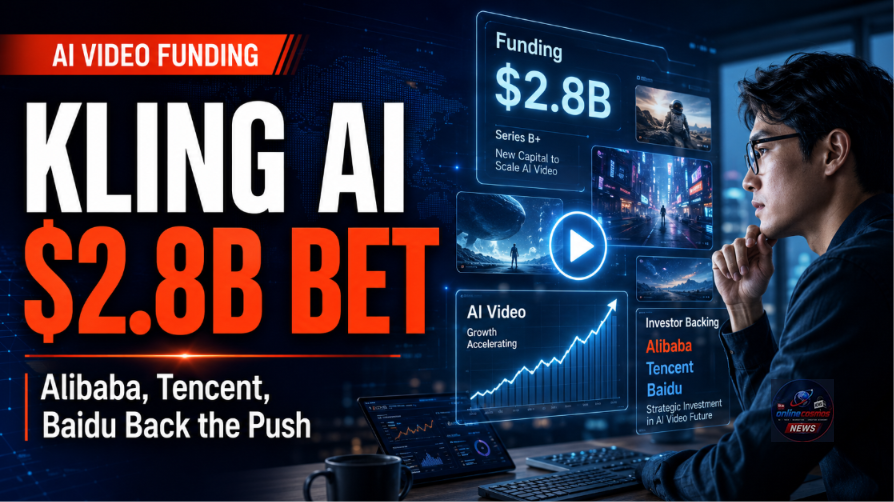
Kling AI has secured nearly $2.8 billion in investment commitments from a group that includes Alibaba, Tencent, and Baidu. The deal values the AI video business at $15 billion before the investment and gives it more resources to compete in advertising, entertainment, and creator tools.
AI video used to feel like a clever experiment.
You typed a few words, waited, and received a short clip that was sometimes impressive and sometimes deeply strange.
But the market has changed. AI video is becoming a real business, and some of China’s largest technology companies are now putting billions of dollars behind it.
Kuaishou Technology announced on July 2 that investors had agreed to inject about 19.05 billion yuan, equal to roughly $2.8 billion, into the company that will hold its Kling AI business. The investors include companies connected to Alibaba, Tencent, and Baidu, according to Kuaishou’s filing with the Hong Kong Stock Exchange.
News Summary:
Investors have committed about $2.8 billion to Kling AI.
The total round could grow to $3 billion.
Kuaishou placed a $15 billion value on Kling before the new investment.
Investors include Alibaba, Tencent, and Baidu.
The deal does not confirm that Kling will be spun off or listed on a stock market.
1. The investor list may matter more than the size of the check.
A $2.8 billion investment is large by almost any measure.
But the more surprising part is who agreed to take part.
The filing identifies an Alibaba Cloud subsidiary, Tencent-controlled companies, a Baidu-controlled business, and a long list of investment funds. That means several major technology groups are backing the same AI video company, even though they compete across cloud computing, advertising, social media, and artificial intelligence.
This is not one parent company quietly funding an internal project.
It is a broad group of investors making a shared bet that AI-generated video will become an important commercial market.
And that matters because the next stage of AI video will require more than clever software. Companies will need huge amounts of computing power, research talent, training data, sales teams, and business partnerships.
Kling now has stronger access to all of those things.
2. Kling is no longer being valued like an experimental AI tool.
Kuaishou said Kling’s pre-transaction value was $15 billion.
“Pre-transaction” means the estimated value of the company before the new investment is added.
When the current $2.8 billion commitment is included, the implied value rises to almost $17.8 billion. That calculation is an estimate based on the figures in the filing, not a separate valuation announced by the company.
This places Kling in a very different category from the small AI tools that launch every week.
Investors are treating it as a large technology business with the chance to sell video generation to consumers, creative teams, and major companies.
Reuters reported that the funding round allows another investor to join within about 60 days. The total amount is capped at roughly 20.45 billion yuan, or $3 billion.
“All eyes will now turn to Kling AI’s upcoming upgrade.”
— Citi analysts, as reported by Reuters
The money creates high expectations.
Kling must now show that it can improve its technology while building a stable and profitable service.
3. Revenue growth helps explain why investors are interested.
The investment is not based only on future promises.
Kuaishou’s filing says the Kling business would have produced about 1.1 billion yuan in revenue during 2025 if the restructuring had already been completed.
It also says Kling reached an annualized revenue run rate of about $500 million in March 2026. An annualized run rate takes revenue from a shorter period and estimates what it would look like across a full year if that pace continued. It is not the same as confirmed yearly revenue.

they make campaign contentReuters separately reported that Kling generated 650 million yuan in the March quarter, more than four times the amount from the same period a year earlier.
Those figures indicate that people and companies are already paying for AI video.
But rapid growth does not automatically mean strong profit. Generating video requires costly computer systems, and AI companies must keep investing to train and operate newer models.
So Kling’s revenue is encouraging, but its long-term costs still matter.
4. This is becoming a fight for advertising—not just viral AI clips.
Many people first saw AI video as a tool for making entertaining clips, cinematic scenes, or social media experiments.
The business goal is much larger.
In its filing, Kuaishou said it expects AI video to spread across:
Advertising
E-commerce
Movies and television
Short-form dramas
Animation
Gaming
For marketers, this technology could change how campaign content is made.
A company might generate several versions of a product video, change the setting for different countries, or test multiple opening scenes without filming each version from scratch.
For creators, it could lower the cost of making visual stories that once needed cameras, actors, locations, and editing teams.
OnlineCOSMOS has already covered how platforms are trying to connect entertainment directly with business results, including TikTok’s Growth Max tools for mini dramas. Kling’s funding suggests the production side of that market is also becoming more competitive.
5. More money does not guarantee better videos.
This is the part investors and headlines can make easy to miss.
Funding can pay for better computers and more researchers. It can help Kling release models faster and reach more customers.
But funding cannot guarantee that every generated video will be accurate, natural, or ready to publish.
AI video systems can still struggle with:
Faces changing between scenes
Objects appearing or disappearing
Unnatural body movement
Poor text inside videos
Weak control over detailed prompts
Inconsistent product shapes and branding
Unclear commercial-use rules
These problems matter most to businesses.
A strange hand in an experimental art clip may be amusing. A product changing shape inside a paid advertisement can damage trust.
So marketers should judge Kling by usable output—not just model demos, investor names, or funding totals.
6. Creators will have better tools but also faster change.
The funding could help Kling lower generation costs, enhance the quality of the video, and get features out faster.
That would be useful for creators and small businesses that cannot afford traditional video production.
But faster competition creates another problem: tool churn.
A creator may build a full workflow around one AI video platform, only to see another platform release a better or cheaper model a few months later.
That makes long contracts and large prepaid plans more risky.
A safer approach is to keep prompts, scripts, source images, and finished files stored outside any one platform. Businesses should also test the same project across two or three tools before committing to a long-term workflow.
This pattern is not limited to video. OnlineCOSMOS recently examined how lower-cost Chinese models are challenging larger AI companies in its report on GLM-5.2 and the growing budget AI market.
7. Kuaishou is giving up some control—but not the company.
Kling’s assets and operations are being moved into a company called Beijing Kling as part of a wider restructuring.
Kuaishou currently owns the business. But the filing says its stake could fall to about 68.33% if the full investment limit and employee share programs are used.
This is called dilution.
Dilution means a company owns a smaller percentage after new investors or employees receive shares.
Kuaishou would remain the controlling owner under the disclosed plan. But Kling would have more outside shareholders and a more independent structure.
That could make future fundraising easier.
It could also prepare the company for a later spin-off or stock market listing—but neither move has been confirmed.
8. Reports of a future Kling listing should be treated carefully.
Some reports have connected the restructuring to a possible separation from Kuaishou and a future Hong Kong listing.
But the official filing does not announce an initial public offering.
Reuters said Kuaishou had acknowledged early talks about restructuring Kling after earlier media reports of a possible spin-off. The company said those discussions were still at an early stage.
That distinction matters.
A company can restructure a business, bring in investors, and create employee share plans without immediately listing it on a stock exchange.
So the confirmed news is the investment and restructuring.
A Kling IPO remains possible, but it is not yet a settled fact.
9. The real test will be whether Kling becomes dependable.
The funding gives Kling the resources to compete with some of the largest names in AI video.
But creators and marketers do not choose tools because of valuation.
They choose tools because they can produce useful work at a reasonable cost.
Over the coming months, the most important signals will be:
Whether Kling improves character and product consistency
Whether generation becomes faster and cheaper
Whether business-use rights become clearer
Whether its tools work reliably across languages and markets
Whether companies can connect Kling to real production systems
Whether customer revenue grows faster than computing costs
The $2.8 billion investment tells us that major investors believe AI video can become a large business.
It does not tell us who will win.
That will depend on something much less dramatic than a funding headline: which platform can repeatedly turn an idea into a video that a real customer is willing to publish?