


Update — September 11 2026: I expanded this review based on the 4 steps of the commission cycle, including Attract, Convert, Ascend, and Compound, the Comment Loop, and the higher-ticket crossover. My overall verdict has not changed.

I started affiliate marketing in 2008.
So when someone tells me they have discovered a “new” affiliate marketing system, my initial reaction usually isn’t excitement.
It’s a mix of curiosity and skepticism.
I’ve watched traffic strategies rise and fall.
* SEO changed.
* Paid advertising changed.
* Social media changed.
* Platforms disappeared.
* Algorithms became harder to predict.
And now AI is changing how quickly almost anyone can produce content.
But the basic economics of affiliate marketing haven’t changed much.
You still need to:
Find the right person, understand what they want, put the right offer in front of them, make a sale, and discover a profitable way to repeat the process.
That is why Mark Ling’s Commission Cycle interests me.
Not because I believe Mark has discovered a magical affiliate loophole.
He hasn’t.
What caught my attention is something more practical.
The commission cycle appears to take an old affiliate principle and rebuild it around how people actually behave online in 2026:
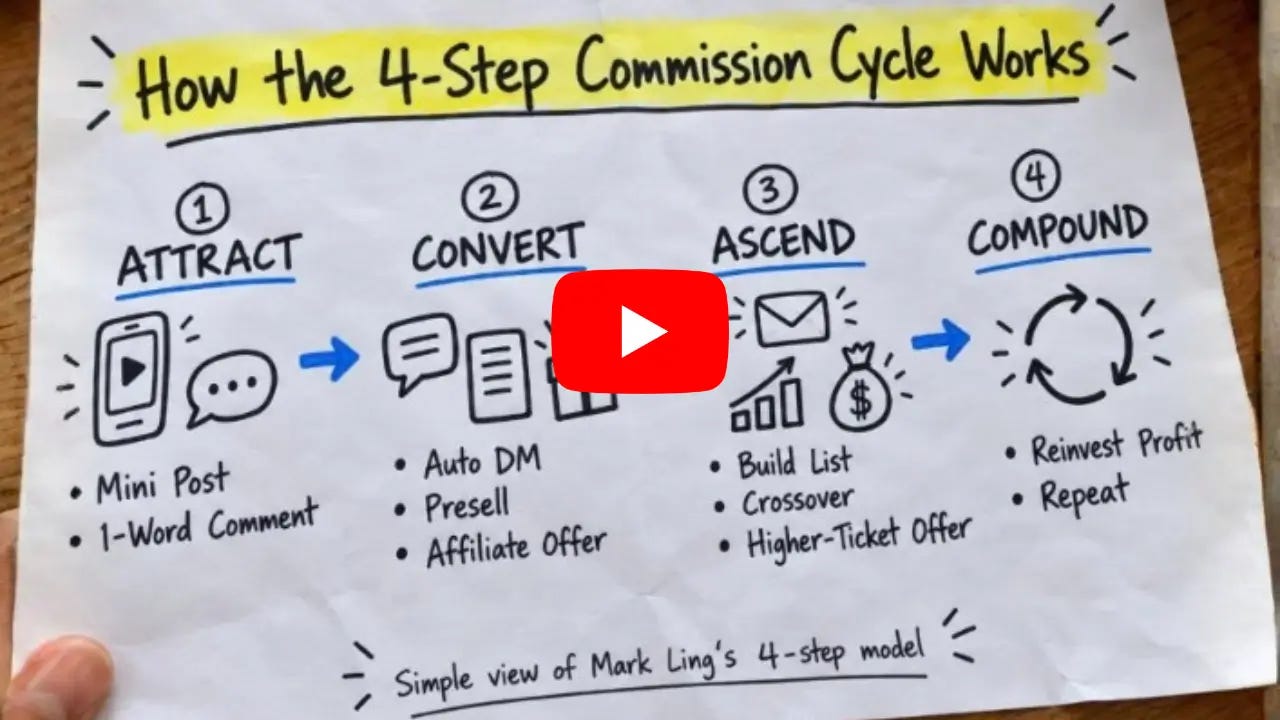
The commission cycle follows four stages:
Attract, Convert, Ascend, and Compound. A short mini post generates a comment, automation turns that interest into a conversation and affiliate offer, suitable buyers can move to a higher-value crossover offer, and part of the resulting commissions can be reinvested into the next cycle.
That is a much more interesting proposition than “use AI to make affiliate commissions”.
But there’s an obvious problem.
The commission cycle costs $2,497, or six payments of $497.
At that price, “interesting” isn’t enough.
So in this Commission Cycle review, I want to answer the questions I would personally ask before putting my money into it:
What is actually new here?
What is simply proven affiliate marketing using newer technology?
Where could this system fail?
Who is it really suited to?
And ultimately:
Is the commission cycle worth $2,497?
My answer is potentially yes for the right person, but definitely not for everyone.
Let me explain why.
Commission Cycle Review: My Quick Verdict
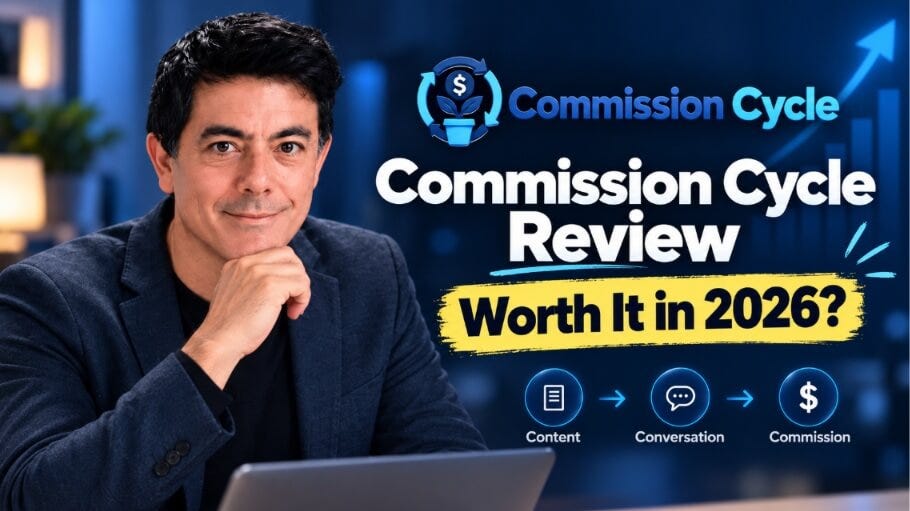
Here is my opinion before we go deeper.
I believe the commission cycle’s business logic is more robust than the individual tactics used for its execution.
That’s important.
Instagram can change.
ManyChat can change.
AI tools will change.
The current viral-post formats will eventually change.
But the underlying model is much harder to make obsolete:
Get attention → identify interest → start a conversation → recommend something relevant → generate profit → reinvest intelligently.
That is what makes the Commission Cycle worth investigating.
However, I would not buy a commission cycle if you’re looking for passive income without consistent execution.
You will still need to create content, understand an audience, test offers, communicate with prospects, and improve what isn’t working.
AI can reduce the workload.
It cannot replace business judgment.
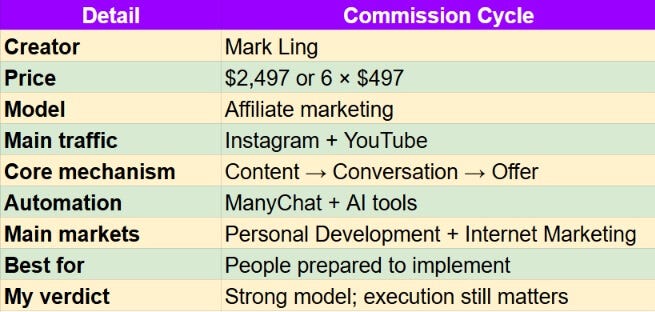
Commission Cycle at a Glance
Creator: Mark Ling
Price: $2,497 or 6 payments of $497
Business model: Affiliate marketing
Primary traffic sources: Instagram and YouTube
Core idea: Turn social attention into conversations and affiliate commissions
Automation: ManyChat and purpose-built AI tools
Main markets: Personal Development and Internet Marketing / Make Money Online
Existing email list required: No
Long-term email list building: Yes
Best suited for: People willing to actively build an affiliate business
My verdict: Strong underlying model. The real value will depend on implementation, offer selection, and whether the traffic strategy fits you.
→ See Mark Ling Explain the Commission Cycle in the Free Training
What Is a Commission Cycle?
The Commission Cycle is Mark Ling’s affiliate marketing program built around what he calls his Profit Shortcut traffic strategies and the broader CommissionCycle scaling model.
Mark Ling describes the commission cycle as a four-step system:
Attract
Convert
Ascend
Compound
This isn’t simply “post on Instagram, automate a DM, and hope someone buys.”
The intended system moves a person through several stages: attract attention with a short post, convert that response into a conversation and affiliate sale, identify suitable buyers for a higher-value offer, and then reinvest part of the resulting commissions into the next cycle.
One of the main strategies is surprisingly simple.
You publish content designed to generate a response.
For example:
“Comment PLAN and I’ll send it to you.”
A person replies.
That response gives you something more useful than another anonymous view.
It tells you:
This person is interested.
Automation can then help continue the interaction.
Instead of the traditional:
Content → Affiliate Link → Sales Page
The model becomes closer to:
Content → Response → Conversation → Recommendation → Sale
That extra conversation is one reason I find the strategy intriguing: it gives you an opportunity to learn more about someone’s intent before pushing them toward an offer.
What I Think the Commission Cycle Is Really Selling
This course is where my interpretation is different from many surface-level reviews.
On the surface, Commission Cycle looks like a course about:
Instagram
YouTube
ManyChat
AI
Viral posts
And, of course, affiliate marketing
But I don’t think those things are the real product.
The Official 4-Step Commission Cycle
When I originally looked at Commission Cycle, I simplified the mechanism as
Content → Conversation → Offer → Commission → Reinvest
That is still directionally correct.
However, Mark’s explanation provides a much more precise picture of what he is actually teaching in the 4-step system.
Step 1: Attract
Mark calls the content a “Mini Post.”
It’s roughly a 45-second social video with one main job: attract the viewer interested enough to comment a simple word.
Rather than immediately telling people to click a link in bio, the content starts with an interaction.
The Mini Post is built around a short video and one simple request to comment a word.
Step 2: Convert
The Instagram comment can trigger an automated DM conversation.
It is a short exchange of two or three messages. Instead of immediately dropping an affiliate link, the person is then sent to a simple presell page that explains the problem and introduces the solution before the main affiliate offer.
This detail matters very much.
You’re not simply automating a link.
You’re creating a small bridge between curiosity and the actual offer.
This sequence is Auto DM Exchange → Presell Page → Affiliate Offer.
Step 3: Ascend
This step is probably the part I underestimated when I first evaluated the Commission Cycle.
The system isn’t designed to end with one small affiliate purchase.
The DM process can also help build an email list. Mark then teaches what he calls a “crossover”; it’s all about identifying people who may genuinely be interested in a related higher-value offer.
Economically, that changes the model from
Get traffic → Make one commission
into:
Acquire buyer → Build relationship → Increase customer value
Mark describes Ascend as “the list → the crossover → the $2,500 offer.”
Step 4: Compound
Finally, some of the commissions can be reinvested into more content, additional traffic sources, or tools that improve the process.
That’s why Mark calls it a cycle.
One completed cycle is intended to help finance the next one.
The commissions from the earlier stages can be reinvested into posts, another traffic source, and tools.
This makes me more interested in the commission cycle than the phrase “Instagram affiliate marketing” would on its own.
The social tactic may change.
In my opinion, this larger business model—acquisition, conversion, customer value, and reinvestment. It’s much more durable.
If you want to see Mark walk through the mechanism rather than just read my interpretation of it, you can see the free Commission Cycle training here! →
I think Commission Cycle is trying to teach a traffic and profit operating system.
The basic loop looks like this:
1. Attract attention
↓
2. Turn some of that attention into identifiable interest.
↓
3. Start conversations
↓
4. Match interested people with relevant offers.
↓
5. Generate commissions
↓
6. Reinvest part of the profit into the cheapest growth opportunity.
↓
7. Repeat
That distinction matters.
A tactic tells you:
“Use this Instagram post.”
A system tells you:
“Here is why the post exists, what should happen after someone responds, how that response eventually produces revenue, and what you do with the profit.”
The second has much more long-term value.
Who Am I to Review the Commission Cycle?
Before I go further, you may be wondering:
Why should my opinion matter?
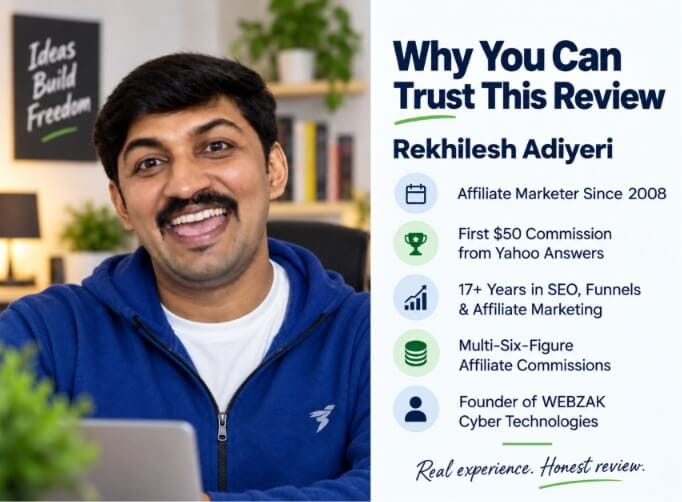
My name is Rekhilesh Adiyeri, and I’m from Kerala, India.
I started affiliate marketing back in 2008 while I was in college.
The internet was entirely different that time.
- There was no ChatGPT.
- No Instagram Reels.
- No ManyChat.
- There is no AI system that can create scripts, graphics, and videos in minutes.
For almost 8 months, I made almost nothing online.
Then one day I answered a question on Yahoo Answers and recommended a web hosting service (HostGator) to a person who asked how to make a website. I guided him with the knowledge I acquired in 8 months.
That simple answer generated a $50 affiliate commission.
It only took a few minutes to write.
That experience changed how I looked at affiliate marketing.
It taught me something I still believe today:
You don’t always need a lot of traffic. You need the right person, with the right problem, to see the right offer.
I have spent more than 17 years applying that lesson in different ways.
I’ve worked across affiliate marketing, SEO, funnels, paid traffic, content, email marketing, and product launches.
Along the way, I’ve generated multi-six-figure affiliate commissions, experienced 5-figure commission months, competed on major launch leaderboards, and had individual days when affiliate commissions reached thousands of dollars.
I’ve also experienced the other side.
* Traffic disappears overnight.
* Algorithm changes affected my website’s growth.
* Platforms shut down, and I lost my network and communities.
* Accounts are restricted, and lost social media profiles with huge followings.
* Strategies that once worked extremely well can become much harder.
That’s why I don’t judge Commission Cycle by whether a new Instagram tactic looks exciting.
I ask a different question:
Do the economics underneath the tactic make sense?
I’m also already a student of some of Mark Ling’s other products.
So I’m not evaluating an unknown instructor based entirely on a sales presentation.
I have previous experience with Mark’s teaching.
But I also want to be clear:
I am not claiming that I have already generated results using the Commission Cycle itself.
I’m evaluating this specific program based on its model, what it teaches, my previous experience with Mark’s training, and my own long-term experience in affiliate marketing.
And of course I will update this review after the purchase and will share my case study as well.
See how OnlineCosmos separates research-based evaluations from hands-on product reviews.
That’s the perspective behind this review.
You can read more about my background and OnlineCosmos here.
How the Commission Cycle Model Works
This section is the most important part of the entire program.
Mark breaks business profit into four major levers:
Leads × Conversion Rate × Average Dollars per Sale × Average Number of Sales per Customer
Let’s strip away all the marketing language, and those four variables make sense.
To make more money, you generally need to:
Get more potential buyers and convert a greater percentage of them.
Increase how much each transaction is worth, or increase how often customers purchase.
Commission Cycle then introduces a reinvestment loop. A portion of the generated commission is reinvested into the lever that is currently the easiest or most cost-effective to improve.
For example:
Traffic is working cheaply?
Invest there.
Organic content is producing strong results?
Create more.
Traffic is beneficial, but conversions are weak?
Improve conversion instead.
A stronger offer produces more profit per sale?
Focus there.
Then additional profit gives you money to reinvest again.
That’s the cycle.
And in my view, this idea has considerably more value than any particular social media trick.
Because traffic platforms change.
Business economics don’t change nearly as quickly.
What’s Inside the Commission Cycle Members Area
Currently, this is my pre-purchase evaluation.
Once I obtain access to Commission Cycle, I plan to document what is actually inside, what I implement, how much work it takes, what works for me, what doesn’t, and whether my opinion changes.
Subscribe to OnlineCosmos if you’d like the hands-on update when I publish it.
Commission Cycle vs Traditional Affiliate Marketing
Here is the simplest way I see the difference.

This trend doesn’t mean traditional affiliate marketing is dead.
Far from it.
I still believe SEO, email, paid traffic, and other traditional channels have value.
What interests me is the additional layer the Commission Cycle puts between attention and offer:
“CONVERSATION”.
The Comment Loop: Why the One-Word Reply Matters
You have probably seen this style of marketing already.
Someone publishes:
“Want my checklist? Comment GUIDE.”
Or:
“Comment AI, and I’ll send you the process.”
A user responds.
That action matters.
A person who watches a reel may simply be entertained.
Someone who comments asking for something has expressed intent.
That doesn’t automatically make them a buyer.
But they are no longer completely passive.
The business now has an opportunity to continue the conversation.
That’s where automation enters.
Mark calls this the Comment Loop.
His argument is based on the order in which the actions happen.
The traditional affiliate approach often looks like
The traditional affiliate approach typically follows this sequence:
Post → Link in Bio → Leave the Platform.
Commission Cycle instead attempts:
Post → Comment → DM → Reply → Link
The idea is that the social platform sees engagement before the person leaves for an external page.
The logic makes sense to me.
But I would be careful about treating any statement about “what the algorithm rewards” as a permanent rule.
Instagram and YouTube can change their ranking systems.
I would treat the comment loop as a traffic hypothesis worth testing, rather than assume that every comment or DM automatically produces more reach.
Where ManyChat Fits
ManyChat helps automate parts of what happens after someone responds.
That can be useful when responses start increasing.
But ManyChat should not be confused with the business model.
Automation works only because something useful happened first:
Someone saw relevant content.
Became interested
And took an action
If your content is weak, ManyChat won’t fix it.
If you’ve attracted the wrong audience, automation may simply help you communicate with the wrong people faster.
Technology multiplies a process.
Ensure that the process is effective before implementing it.
Want to see the automation part in action?
This short tutorial from ManyChat shows how a comment on Instagram can trigger an automated DM. This is a ManyChat tutorial, not Commission Cycle training. But it helps explain the technology behind the comment loop.
The presell page is an important piece.
The automated DM does not necessarily send someone directly to the affiliate sales page.
The proposed flow uses a one-page presell page in between.
That page frames the problem and introduces the solution before sending the visitor to the actual affiliate offer.
I like that structure more than immediately dropping a high-ticket affiliate link into someone’s inbox.
It gives you an opportunity to explain why the offer may be relevant before asking the vendor’s sales page to close the sale.
How AI Fits Into the Commission Cycle
Commission Cycle also uses its AI tools to reduce much of the manual workload involved in areas such as
Research,
Script creation
Social media posts
Images
And videos
For a one-person business, that could be valuable.
Creating content manually can consume a huge amount of time.
Research.
Writing.
Graphics.
Video.
Editing.
Publishing.
Then do all of it again tomorrow.
AI can dramatically reduce that friction.
But I would not buy Commission Cycle just for its AI tools.
The year is 2026.
AI tools are improving too quickly to treat any individual tool as a permanent advantage.
Something impressive today can become ordinary surprisingly fast.
So my test is:
Would Commission Cycle still make sense if I removed the AI tools?
For me, yes.
You would still be:
Finding demand
Creating useful content
Starting conversations
Matching prospects with offers
Measuring results
And reinvesting profits
The AI simply makes execution faster.
AI is a lever. It isn’t the business.
Why Instagram and YouTube?
Commission Cycle primarily uses Instagram and YouTube as traffic sources.
That makes sense for this model.
Both platforms combine:
Discovery
Content
Engagement
And audience building
But I particularly like one part of Mark’s approach:
You do not need an existing email list to begin, but list building is still encouraged as the business grows.
That is important to me.
I have experienced enough platform changes to be uncomfortable building a business entirely on rented attention.
Instagram can give you reach.
YouTube can give you reach.
An email list gives you a more direct relationship with your audience.
My preference would be:
Use social platforms to acquire attention, then gradually turn that attention into assets you control more directly.
Is Commission Cycle Traffic Really “Owned”?
There is one part of the Commission Cycle positioning where I would use slightly different language from Mark. Mark’s report strongly positions the traffic as “yours” and contrasts it with rented paid traffic.
I don’t view Instagram or YouTube traffic as genuinely owned.
Organic reach may be free in the sense that you’re not paying for every impression or click.
But Instagram still owns Instagram.
YouTube still owns YouTube.
They control distribution, policies, and account access.
I know this distinction personally because I’ve experienced what happens when platforms, algorithms, and traffic sources change.
So I would describe this as earned social traffic, not completely owned traffic.
The real asset begins forming when those social interactions turn into things you can carry with you:
An email list, audience trust, customer relationships, knowledge about your market, and the skill to acquire attention repeatedly are all valuable assets.
That doesn’t weaken the Commission Cycle idea.
In my opinion, it makes the long-term strategy clearer.
What The Free Report Actually Teaches (And What It Doesn’t Tell You)
Before you drop $2,497, Mark Ling gives away a free report called “The Backwards 4-Step ‘Cycle’ That Turns 1-Word Comments Into Affiliate Commissions in 2026.”
I read it. Here’s what it promises and what I think you should watch out for.
What the report says:
The “Comment Loop” mechanic: used by fewer than 1 in 100 accounts
A 45-second “mini post” filmed on your phone that does the selling for you
Roughly 25% of any audience also wants make-money-online content (the “Hidden Buyers” crossover).
Automation tools that make “90% of the work run itself”
What I found interesting:
The Comment Loop angle is genuinely smart. Many people continue to simply paste a link in their bio and wait for results. Using a keyword trigger to start a DM conversation is a higher-intent mechanic, and the report’s claim of a 17.8% opt-in rate vs. a 4.2% bio-link rate tracks with what I’ve seen in practice.
The “45-second mini post” thing? It works, but it’s not magic. You still need to post consistently. The compound effect is real; a good post keeps bringing in comments weeks later. But “90% runs itself” assumes you’ve already done the setup work and posted enough volume to find what sticks.
The free report is not just fluff; it provides valuable insights. It gives you a real framework. But if you read it and think, “I can do this without buying the course,” you probably can, but you’ll be missing the AI tools, the session-by-session walkthrough, and the automation templates that save you weeks of trial and error.
Which Niches Does Commission Cycle Focus On?
Commission Cycle primarily concentrates on two markets:
Personal Development
and
Internet Marketing / Making Money Online.
That is not a minor detail.
If you already operate in these markets, the training may be particularly relevant.
Personal development itself contains many sub-markets.
Internet marketing also has a large supply of products and affiliate opportunities.
But if your expertise is something entirely different, say industrial engineering or local dentistry, I would not automatically assume every tactic transfers perfectly.
The underlying economics may transfer.
The exact content and offer strategy may require adaptation.
Hidden Buyers: Interesting Economics, but Trust Matters
Another interesting part I want to clarify is what Mark calls “Hidden Buyers.”
His idea is that someone who enters through one personal development interest may also have an interest in building income or an online business.
Instead of assuming everyone wants the higher-ticket offer, the crossover is supposed to identify the people who actually show interest.
According to Mark Ling, based on his experience across different markets, roughly a quarter of some audiences may also have an interest in making money online. He gives different percentages for different niches.
I understand the economics.
If you can increase the value created from the same audience without buying more traffic, the entire affiliate model becomes more attractive.
But this is also where I think marketers need the most discipline.
I would not interpret “some people may want a higher-value offer” as permission to pitch a money-making product to everyone.
The crossover needs to make sense for that person’s actual interests.
Otherwise, you may improve short-term monetization while damaging something more valuable:
It’s “TRUST”.
For me, that is the real constraint on the Ascend strategy, not simply whether the funnel technically converts.
What I Like About the Commission Cycle
1. It Uses Existing Demand
You don’t necessarily have to invent a new product.
You’re connecting an existing problem with an existing solution.
That’s one of the biggest advantages affiliate marketing has always had.
2. It Turns Passive Attention Into Active Intent
A view is useful.
A follower is useful.
But someone deliberately requesting information gives you a stronger signal.
The commission cycle is designed around that distinction.
3. Conversations Come Before the Offer
This approach could potentially result in more relevant recommendations.
I also prefer this approach from an ethical standpoint.
Understand the person first.
Recommend second.
4. The AI Has a Clear Job
The AI tools aren’t being positioned as the business itself.
They’re there to reduce production workload.
That is where AI makes the most sense to me.
5. The Scaling Logic Is Sound
This is the strongest part.
Generate profit.
Find the best lever.
Reinvest.
Measure.
Repeat.
That’s not exciting marketing language.
It’s simply good business logic.
What Concerns Me About Commission Cycle
A serious review needs to discuss where the commission cycle system could fail.
1. The $2,497 Price
The price is a significant investment.
At $2,497, or 6 × $497, I would not treat Commission Cycle as an impulse purchase.
If paying for it would create financial pressure, I would be cautious.
The money is only one part of the investment.
You’ll also need time and attention to implement it.
2. You Still Need Attention
AI does not guarantee views.
ManyChat does not guarantee conversations.
And conversations don’t guarantee purchases.
You still need to understand:
Your audience
Their problems
Content
Offers
Hooks
Positioning
And testing
The commission cycle may organise those pieces.
It cannot make fundamentals disappear.
3. The Model Requires Execution
Every large online course carries a risk.
People buy information instead of implementing it.
If you already own ten unfinished business programs, buying number eleven may not fix the underlying problem.
Before buying a commission cycle, I would ask:
Will I actually use this program for the next 60–90 days?
If the honest answer is no, save your money.
4. Platform Dependency Still Exists
This deserves more attention.
Instagram and YouTube are still rented platforms.
Yes, Commission Cycle teaches email list building.
I like that.
But I would personally make list building an important part of implementation rather than an optional extra.
I’ve learned this lesson through experience.
5. The Main Markets May Not Fit You
Personal Development and Internet Marketing is a large opportunity.
They are also competitive.
Don’t enter a market you dislike simply because a training program recommends it.
Long-term consistency becomes much harder when you have no genuine interest in the people you’re serving.
What is the actual cost of the Commission Cycle system?
Here’s the thing about the pricing, and I want to be upfront here because most reviews gloss over the details.
The course itself is $2,497 if you pay once. That’s the number you’ll see everywhere.
But here’s what I don’t see enough people spelling out:
Payment Option: What You Actually Pay
Pay in full—one time: $2,497
6 monthly payments: 6 × $497 = $2,982
Your savings by paying once: $485
That $485 gap matters. The installment plan costs you about 19% more than the single payment option. Most affiliate launch pages won’t disclose this information; instead, they will only present the $497/month figure because it appears the $497/month figure looks smaller. But the math is the math.
Is the payment plan worth it? If cash flow is tight? Sure. Six months to pay off a $2,500 course isn’t bad. But if you can pay the full payment, you’re saving nearly five hundred dollars that you could be putting into ManyChat or your first ad test instead.
What The Sales Page Doesn’t Tell You About Additional Costs
Look, the $2,497 gets you the training, the AI tools, and access to the live sessions. That’s all true.
But there are two tools you’ll need that aren’t included in that price:
ManyChat Pro: This tool is the automation backbone for the Comment Loop system. You need it to run the DM sequences. Cost runs $15 to $65 per month depending on your contact count and features.
An email service provider: You’ll want an email service provider for long-term list building. It costs around $29 to $79 per month for something decent.
So your real first-year working capital includes the course plus tools, landing somewhere around $3,000 to $3,800 for your first year (or an extra $45 to $140 per month in software on top of the course investment).
I’m not saying this to scare you off. I’m saying it because the difference between knowing this upfront and discovering it after you buy is the difference between a smooth start and a frustrated one. So, you could budget accordingly.
Who Should Consider a Commission Cycle?
I think Commission Cycle makes the most sense if you:
Genuinely want to build an affiliate business
Are willing to create content consistently
Are comfortable using Instagram or YouTube
Like the idea of conversational selling
Want AI to improve productivity rather than replace you
Can afford the investment responsibly
And are willing to test the system instead of expecting instant results
You do not necessarily need years of experience.
But you do need to execute.
Who Should Probably Skip It?
I would probably skip the commission cycle if you:
Want guaranteed income
Expect instant passive income
Refuse to create content
Don’t want to communicate with prospects
Expect AI to run the entire business
Cannot comfortably afford the price
Or regularly buy courses without implementing them
Commission Cycle may provide a system.
It cannot provide discipline for you.
Is Commission Cycle Right For You?
My audience frequently asks me this question, so I’ll simplify it.
This is for you if:
You have zero email list and don’t want to build one the right way.
You’re willing to show up and post short-form content consistently (3–4 times a week minimum).
You like systems that automate the boring parts—DMs, follow-ups, and content creation.
You want a model that adapts when platforms change (Mark Ling has navigated 7 major traffic shifts in 26 years).
You understand that the $2,497 buys you a system, not a result.
This is NOT for you if:
You need money in 30 days or less.
You’re hoping for a “set it and forget it” passive income stream.
You hate being on camera or creating content.
You can’t afford the course plus the tool costs without stressing your finances.
You expect overnight results; the compound model takes months to build momentum.
There’s no shame in any of those being a dealbreaker. Better to know now than after you’ve paid.
What About Mark Ling?
This part matters to me personally.
Mark Ling didn’t enter affiliate marketing during the recent AI boom.
He has been operating in the industry since around 1999.
Affilorama followed in 2006.
That means his career has crossed several completely different generations of online marketing.
Search engines.
Websites.
Email.
Paid advertising.
Product launches.
Social media.
Automation.
And now AI.
Furthermore, Mark is a multiple-time ClickBank Diamond award winner. ClickBank has confirmed that students across his past programs generated more than $400 million in sales.
That history doesn’t guarantee that every product Mark creates will be successful for every student.
It does tell me that he’s had to adapt repeatedly.
I also have personal experience as a student in some of his other training programs.
So I don’t have the same uncertainty I would have with an instructor I discovered yesterday.
Still, I am judging the Commission Cycle separately.
A good teacher can still create an offer that isn’t right for you.
An interesting parallel between Mark’s first commission and mine
One detail from Mark’s story that caught my attention was his first affiliate commission.
He says his first affiliate commission came in 1999 from a Britney Spears fan page that linked visitors to an online dating offer.
Mine came nine years later after answering a question on Yahoo Answers and recommending HostGator.
Entirely different websites.
Entirely different eras.
But underneath them was the same idea:
Attention + Intent + Relevant offer.
One reason I don’t dismiss Commission Cycle is that its current execution, which involves Reels, comments, and AI, still holds value.
The platforms change much faster than the fundamental transaction.
What’s the Profit Engine LIVE launch schedule?
The commission cycle doesn’t just drop and vanish. It’s a full multi-session event running from September 8 through September 24. Here’s how it breaks down:
Date: What’s Happening
Sep 8–Sep 13: Pre-launch—opt-in period, affiliate leads build
Sep 15 – Sep 16: Profit Engine Live — 3 sessions per day
Sep 19–Sep 20: Profit Engine Live 2—deeper training
Sep 22–Sep 23: Profit Shortcuts & Secret Strategy Sessions
Sep 24: Blueprint Day + Cart closes at 11:59 PM PST
That’s 6 full sessions across the two main event days, plus additional workshops on the backend. Each session runs about 90 minutes and happens once; in my understanding there are no replays of the same content.
Why this matters: If you buy during the launch window, you get access to all of this live. After the cart closes on September 24, the product shifts to a different format. The live event energy is part of what you’re paying for.
Is the Commission Cycle Worth $2,497?
Here’s how I would make the decision.
Don’t ask:
“Can Commission Cycle make me $2,497?”
No training program can responsibly promise that.
Instead ask:
“Is this program a business system I can realistically see myself implementing for the next few years?”
That changes the calculation.
If you’re committed to building an affiliate business around social content,
Social content
Conversations
Automation
Email
And affiliate offers
Then the Commission Cycle deserves serious consideration.
If you’re hoping to make the purchase price back quickly without changing what you currently do, I would be much more cautious.
The Biggest Insight I Took From the Commission Cycle
After studying the offer, my biggest takeaway isn’t about Instagram.
It’s not ManyChat.
And it isn’t AI.
It is this:
The biggest insight I now see in the Commission Cycle is that the front-end affiliate commission is not supposed to be the end of the model. It’s the beginning of the cycle.
Attract gets attention.
Conversion monetizes some of it.
Ascend attempts to increase the value of the relationship.
Compound uses part of that value to fund more acquisitions.
That is much closer to how I think about a real business than simply posting affiliate links and hoping people click.
Affiliate marketing works best when you stop thinking only about traffic and start thinking about the economics of the entire customer journey.
Where does attention come from?
What gets someone to respond?
What converts that interest?
How much is each sale worth?
Can the same customer create additional value?
Where should the next dollar of profit be reinvested?
Those are better questions than:
“Which traffic hack works this month?”
That’s the part of the Commission Cycle with the longest shelf life.
Does Commission Cycle Have a Refund Guarantee?
Yes, there is a 30-day conditional, action-based guarantee.
Because the offer is a $2,497 purchase, I would check the exact refund terms shown at checkout before paying. Particularly the refund period, whether the guarantee is conditional, and whether you need to complete specific implementation steps to qualify.
Commission Cycle FAQ
What is a commission cycle?
Commission Cycle is Mark Ling’s affiliate marketing training program built around social traffic, conversations, affiliate offers, and a profit-reinvestment model designed to scale a profitable digital business.
How much does the commission cycle cost?
The current price is $2,497, or six payments of $497.
What traffic sources does Commission Cycle use?
The training focuses primarily on Instagram and YouTube, supported by ManyChat automation, shareable resources, and longer-term email-list building.
Do I need an email list?
No existing email list is required to start. However, the system also teaches list building, which I consider important for reducing long-term dependence on social platforms.
Does Commission Cycle use AI?
Yes. AI tools assist with areas including research, scripts, social posts, images, and videos. I view the AI as an execution accelerator rather than the core business model.
What niches does Commission Cycle focus on?
The primary markets are personal development and internet marketing / making money online, although the underlying concepts may be adaptable to other markets.
Is the commission cycle beginner-friendly?
A beginner should be able to understand the model, but beginner-friendly does not mean effortless. You’ll still need to publish, test, learn, and implement.
What are the four steps of the commission cycle?
The 4 stages of the commission cycle system are Attract, Convert, Ascend, and Compound. Attract uses short social content to generate comments; Convert moves interested people through automated messaging and a presell page; Ascend identifies suitable buyers for higher-value offers; and Compound reinvests commissions into further growth.
What is a Commission Cycle Mini Post?
Mark describes a “Mini Post” as a short social video, around 45 seconds, that is built around an opening idea and one simple call to action, typically asking the viewer to comment a word.
Can the commission cycle system be built in 14 days?
Mark says his live training will teach a 14-day build of the system. I would interpret that as a setup/implementation timeline, not as a promise that someone will become profitable within 14 days. The report’s earnings disclaimer also makes clear that results aren’t guaranteed.
Is the commission cycle legitimate?
Commission Cycle is created by longtime affiliate marketer Mark Ling, whose public affiliate-marketing history stretches back to the late 1990s. The more important question for a buyer isn’t simply whether the program exists; it’s whether the strategy, price, and required execution fit their situation.
Is the commission cycle worth buying?
For someone committed to building an affiliate business around modern social traffic, conversations, and automation, I think it deserves serious consideration.
For someone seeking guaranteed or zero-work income, I would pass.
Is the commission cycle worth $2,497?
It depends on execution. If you post consistently, follow the system, and reinvest profits, the math works. If you buy and sit on it, no amount of training will generate a commission.
What is the refund policy?
It’s a 30-day conditional, action-based guarantee. You will need to demonstrate that you have actively engaged with the training and implemented the system. This isn’t a “change your mind” refund; it’s a “we tried and it didn’t work for you” refund.
Does the Commission Cycle require a website or email list?
No to both. You can start without either. The system routes through social media comments and automated DMs. An email list is taught as an upgrade, not a prerequisite.
What hidden costs should I expect?
ManyChat Pro runs $15–65/month depending on your subscriber count. An email service provider adds $29–79/month if you go that route. Budget roughly $2,350–$2,650 total for your first year, including the course.
Can a complete beginner succeed with the course?
Yes—if they post consistently. The system is designed to work without prior experience. But consistency beats strategy every time. Someone who posts daily with average content will outperform someone who posts weekly with perfect content.
Commission Cycle Review: My Final Recommendation
I came into this review with a different perspective from someone discovering affiliate marketing for the first time.
I’ve been doing affiliate marketing since 2008.
I’ve experienced great years.
I’ve experienced painful setbacks.
I’ve watched traffic methods become incredibly profitable and later become dramatically harder.
And I’ve previously learned from Mark Ling.
So I wasn’t trying to answer:
“Does affiliate marketing work?”
I already know that it can.
I wanted to know:
“Does the commission cycle represent a sensible way to practice affiliate marketing in the current environment?”
My answer is
Yes, the underlying model makes sense to me.
What remains to be proven for each buyer is the execution.
The strategy still requires:
Attention
Good offers
Useful content
Testing
Conversation
Consistency
There is no magic hiding underneath the AI.
And strangely, that’s one reason I like it.
At its core, Commission Cycle comes back to principles that have worked throughout my affiliate career:
Identify someone who is facing a genuine challenge.
Earn their attention.
Start the right conversation.
Recommend something useful.
Make a profit.
Then intelligently turn some of that profit into more opportunities.
The technology is different.
The principle isn’t.
My Final Thoughts
The commission cycle is worth serious consideration if you want to build an active affiliate business using social traffic, conversations, automation, and AI-assisted execution.
I would not buy it because of a countdown timer.
I would not buy it because someone shows an income screenshot.
I wouldn’t even buy it solely because Mark Ling created it.
I’d buy it if the business model fits how I want to operate and I’m prepared to implement it properly.
That’s the standard I’m using for my own decision.
Commission Cycle Price
$2,497 or 6 payments of $497
Best For
Affiliate marketers and serious beginners who want to build around social traffic, conversations, automation, and relevant affiliate offers.
Probably Not For
This training program is probably not suitable for people seeking guaranteed income, completely passive income, or another training program that does not require implementation.
Want to Take a Closer Look at the Commission Cycle?
If the system I’ve described matches the kind of affiliate business you want to build, the next sensible step is to look through the commission cycle yourself.
Don’t buy simply because I see potential in it.
Look at the strategy.
Look at the price.
Look at the work required.
Then ask yourself one question:
“Am I actually going to implement this?”
If the answer is yes, the Commission Cycle becomes much more engaging.
Affiliate Disclosure: This evaluation may contain affiliate links. If you purchase through one of my links, I may receive a commission on that purchase. See my affiliate disclosure and the FTC's guidance on affiliate endorsements. Learn more about our website, authors’ background, testing methodology, and review ethics on the OnlineCOSMOS About Page.
Looking for more independent software breakdowns? Browse our full archive inside the Expert Offer & Tool Reviews section.
For more strategies on building recurring revenue and creator communities, check out our Tactical Insights & Trends guides.
Official References & Independent Verification: