

News Overview:
OpenAI’s EU workforce report says AI may grow some jobs, reorganize many workflows, and increase automation pressure in some roles. The main problem is not just people losing their jobs. How AI changes what makes certain tasks valuable.
OpenAI released a report about the EU workforce on June 29 2026.
The report groups jobs into four AI paths: growth, reorganization, automation pressure, and lower immediate change.
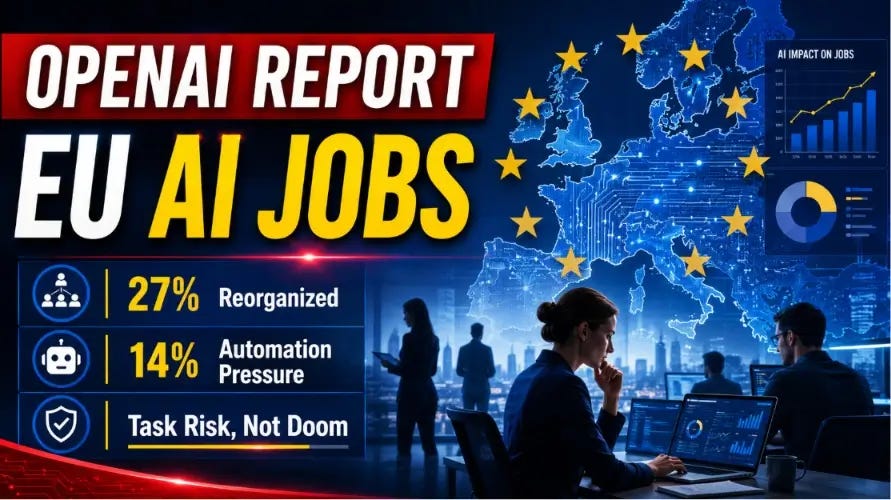
OpenAI says 27% of EU employment may see major workflow changes, while 14% face higher automation pressure.
The report is not meant to predict job losses. It is a tool to help workers, employers, schools and policymakers plan.
Your Job Title Is Not the Risk
Your task list is the risk.
OpenAI’s EU jobs report does not prove that AI will wipe out millions of European jobs.It shows that AI will likely affect tasks that are done over and over before it replaces jobs.
For people who do marketing, create content, freelance or run agencies this is a warning. If your value comes from writing, simple research, reports, summaries or repetitive office work your profit is already in trouble.
What OpenAI Published
OpenAI released The AI Jobs Transition Framework for the EU, a report on how artificial intelligence may affect work across European Union countries.
The report does not treat every job the same. It separates jobs by how AI may change demand, workflows, and automation pressure.
That distinction matters. A role can survive while the work inside it gets cheaper, faster, and easier to copy.
The Key Numbers:
OpenAI groups EU employment into four broad paths:
12% of employment may grow as AI lowers costs and creates more demand.
27% may be reorganized as AI changes workflows.
14% face higher near-term automation pressure.
47% face less immediate change.
Do not misread the 14% number. OpenAI is not saying 14% of EU workers will lose their jobs. It is saying those roles contain tasks that AI may handle more easily.
That is a different risk. But it is still a real one.
AI Is a Workflow Rewiring Tool
Think of AI like a workflow router.
It does not need to replace the whole worker to change the economics of the job. It only needs to take over enough steps in the pipeline to change the price, speed, and skill mix.
A content marketer who only drafts posts is exposed. A content strategist who can research position ideas, edit, verify facts, distribute content and measure results is harder to replace with AI.
The value moves upstream. Judgment beats production volume.
What This Means for Digital Operators
If you sell services online, audit your offer now.
Basic deliverables are getting weaker: blog drafts, ad variations, simple reports, keyword lists, competitor summaries, social captions, and first-pass email copy. AI can already produce much of that at low cost.
Stronger offers connect the work to business outcomes. Think conversion audits, editorial strategy, campaign systems, sales enablement, compliance-safe content, workflow automation, and performance reporting.
You should not sell “content.” You should sell a sharper decision system.
Automation Pressure Is Not the Same as Job Loss
Automation pressure means AI can perform more tasks inside a role. It does not automatically mean the role disappears.
This is the technical detail many headlines will blur. A job may remain, but the worker may need fewer hours, different tools, stronger review skills, or a higher-value service layer.
That is where operators get squeezed first. Not by replacement — by price compression.
Which EU Countries Look More Exposed
OpenAI says country-level exposure depends on each country’s job mix.
Germany, Greece, and Italy show larger shares of employment in higher automation-pressure roles. Luxembourg, Sweden, and the Netherlands show larger shares in roles that may grow with AI.
This is not a “best country versus worst country” ranking. It is a labor-market structure map.
For readers, the useful question is local: what type of work dominates your industry, and how much of it is repeatable?
What This Report Cannot Tell You
This report does not predict exact layoffs.
The report also can’t tell you how quickly companies will start using AI, how unions or regulators will react or how much customers will still want to deal with humans.
The report maps exposure. It does not prove outcomes.
That matters because AI capability is only one variable. Regulation, training, cost, customer trust, legal risk, and company culture all affect what actually happens.
Europe’s Bigger Problem: Adoption Speed
Europe may not only face job disruption. It may also face a productivity gap.
Research discussed by the St. Louis Fed found higher workplace AI use among U.S. workers than among workers in several European countries in early 2026.
That creates a hard tradeoff. Move too slowly, and European firms may protect some workflows while losing speed. Move too fast, and workers may face abrupt task disruption without enough training.
Neither path is clean.
What Marketers, Creators, and Freelancers Should Do
Start with a task audit.
List the work you do each week. Mark each task as one of four types:
AI can already do this well.
AI can draft it, but you must verify it.
AI can assist, but human judgment drives quality.
AI cannot do this without deep context or trust.
Then rebuild your offer around categories three and four.
That is where your leverage sits.
What Employers Should Do
Do not start with “Which roles can we replace?”
Start with “Which workflows are leaking time?”
That shift creates better AI adoption. It lets teams automate low-value steps without destroying institutional knowledge.
Employers should track task time, quality control errors, review bottlenecks, tool usage, and training gaps. Those signals will matter before official labor data catches up.
What Policymakers Should Watch
OpenAI says the report is a warning, not a final prediction.
That makes sense. Governments should keep track of how AI’s used job openings, wages, job changes, training uptake and productivity in different sectors before making big claims.
The EUs AI Act timeline is also important. Rules about high-risk AI in employment are expected to apply from December 2 2027 according to the European Commission.
This means companies using AI in hiring, managing workers or making employment decisions should get ready for checks.
Why Does This Matters to People?
The weak version of this story is: “AI may take jobs.”
The useful version is: “AI will reprice tasks.”
That is the operating reality for solopreneurs. If your work looks like something that can be done over and over, clients will expect it to be done faster and cheaper. If your work reduces risk, helps make decisions or brings in revenue you still have room to charge.
So what do you expect?
Do this in the 24 hours: look at your top five paid tasks.
Mark which ones AI can draft, which ones AI can check and which ones still need your judgment. Then rewrite your service offer around the parts that create trust, strategy, and measurable business value.
Do not wait for your job title to change. The task economics are already moving.