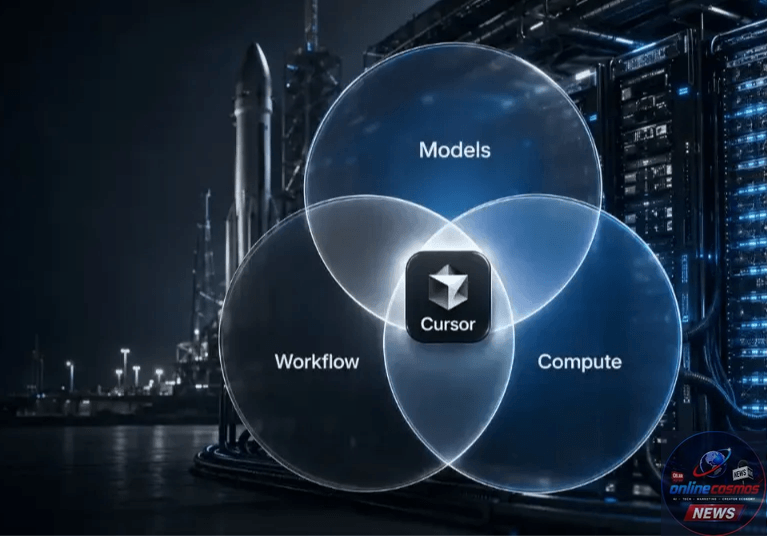
The confetti from SpaceX’s public debut had barely settled before the company pulled out a $60 billion hammer.
Not a rocket company.
Not a satellite startup.
An AI coding tool.
That’s the part people keep tripping over.
SpaceX has agreed to acquire Anysphere, the parent company of Cursor, in an all-stock merger that values the AI coding startup at $60 billion. The deal is expected to close in the third quarter of 2026, assuming regulators don’t decide to drag everyone into a long, fluorescent-lit conference room and make the lawyers earn their retainers.
Cursor will become a wholly owned SpaceX subsidiary if the merger closes. Cursor shareholders will receive SpaceX Class A common stock. And if the whole thing collapses under certain conditions, SpaceX could owe a $10 billion termination fee, with a lower $4 billion fee if antitrust regulators block the deal.
That’s not a breakup fee.
That’s a national budget line item.
But the money isn’t the most interesting part. The interesting part is what SpaceX is actually buying.
It’s not buying “AI coding” in the vague conference-panel sense. It’s buying the conveyor belt inside the software factory.
Cursor is where developers already live
Anyone who has watched engineering teams adopt new tools knows the boring truth: the best product doesn’t always win.
The one that sits inside the daily workflow usually does.
The cursor has that position. It’s not some dashboard a manager checks on Friday afternoon. It’s inside the editor. Inside the codebase. Inside the panic at 11:38 p.m. when the building breaks and nobody wants to touch the payment service because the last person left three months ago.
That matters.
Software engineers don’t want another portal. They don’t want another chatbot tab. They want the thing they’re already using to get smarter without making them feel like they’ve been demoted to prompt typist.
Cursor got that early. It made AI coding feel less like a toy and more like a 2nd set of hands sitting inside the IDE.
“SpaceX isn’t buying a coding app. It’s buying the place where millions of coding decisions happen before anyone else sees them.“
This is where the deal starts to look less weird.
SpaceX, through xAI, doesn’t just need models. Everyone has models now. Models are expensive, messy, and weirdly political. What SpaceX needs is distribution, feedback, usage loops, and a front-row seat to how software actually gets built.
Cursor gives it all four.
The stock makes the deal easier to swallow
A $60 billion acquisition would normally make even aggressive buyers breathe through a paper bag.
SpaceX has a different problem. Its post-IPO valuation gives it a very expensive currency, and it’s using that currency while the market still treats the company like it has gravity turned off.
Because this is an all-stock deal, SpaceX isn’t cutting a $60 billion cash check. It’s converting Cursor shares into SpaceX shares based on the merger terms. That doesn’t make the deal cheap. Dilution is still dilution. But when your market cap has inflated this fast, equity becomes a weapon.
This is the part investors understand immediately.
If SpaceX stock stays strong, it can buy strategic assets with a smaller ownership bite than a normal company would have to give up. That’s a nasty advantage. The kind competitors hate because it’s not just about product quality anymore. It’s about market structure.
And yes, it’s also risky.
SpaceX is now asking public-market investors to believe in rockets, satellites, AI infrastructure, enterprise software, coding agents, and whatever else shows up on the roadmap before lunch. That’s a lot of story to carry in one stock.
At some point, the market may ask for operating proof instead of ambition. Markets have a habit of doing that right after everyone gets comfortable.
This is really about xAI catching up
Let’s not overcomplicate it.
xAI needs help.
OpenAI has developer mindshare. Anthropic has become a serious force in coding with Claude. Google has infrastructure and distribution. Microsoft owns GitHub. Everyone is trying to wedge themselves into the software development process because code is one of the first places AI has shown clear business value.
That last bit matters. A lot of AI still feels like a productivity promise wrapped in a demo. Coding tools are different. Developers use them, budgets follow, and companies can measure some version of the output.
It’s not always clean. Sometimes the AI creates bugs with the confidence of a senior engineer who hasn’t read the ticket. But teams are using these tools anyway because the speed gains are too tempting to ignore.
Cursor gives SpaceX and xAI a shortcut into that market.
Instead of trying to convince developers to switch to a new Musk-built coding product from scratch, SpaceX gets a platform already sitting in the workflow. That’s a cleaner play. Build the model. Push it through the Cursor. Watch what developers accept, reject, rewrite, curse at, and keep.
That feedback loop is gold.
“The AI race won’t be won only by the lab with the smartest model. It’ll be won by the company closest to the work.”
The awkward part nobody wants to say too loudly
Here’s the tension.
Developers like tools that feel independent. They get twitchy when a beloved workflow product gets absorbed into a giant strategic machine.
And they should.
Cursor’s strength has been model flexibility. Developers could use it without feeling completely locked into one AI religion. The risk now is that SpaceX turns Cursor into a house channel for xAI. Maybe not overnight. Maybe not crudely. But the incentive is obvious.
If Cursor becomes too tilted toward SpaceX’s own models, some engineers will look for exits. Not all of them. Maybe not even most. But the developer tools market punishes bad vibes faster than outsiders expect.
Ask anyone who has shipped a pricing change to a technical audience. You’ll learn new vocabulary by breakfast.
So SpaceX has a delicate job here. It needs to extract strategic value from Cursor without making the product feel captured. That’s harder than it sounds, because the moment developers smell forced integration, the goodwill meter starts dropping.
The founders just entered a different league
The deal also turns Cursor’s co-founders — Michael Truell, Aman Sanger, Sualeh Asif, and Arvid Lunnemark — into one of the strangest founder stories in modern tech.
A few years ago, Cursor was another ambitious AI coding startup chasing developer love in a crowded market. Now it’s being valued at $60 billion in a SpaceX stock deal, with some of Silicon Valley’s biggest funds staring at massive paper gains.
That’s the kind of outcome venture capitalists build entire fund decks around.
However it also raises a reasonable question: is Cursor worth $60 billion by itself, or is it worth $60 billion particularly to SpaceX?
Those are not the exact same thing.
To a normal software buyer, the number looks wild. To SpaceX, Cursor may be a wedge into enterprise AI, a training-data flywheel, a developer distribution layer, and a credibility patch for xAI all at once.
That’s how strategic M&A gets expensive. The buyer isn’t paying only for revenue. It’s paying for time.
And in AI, time has become stupidly expensive.
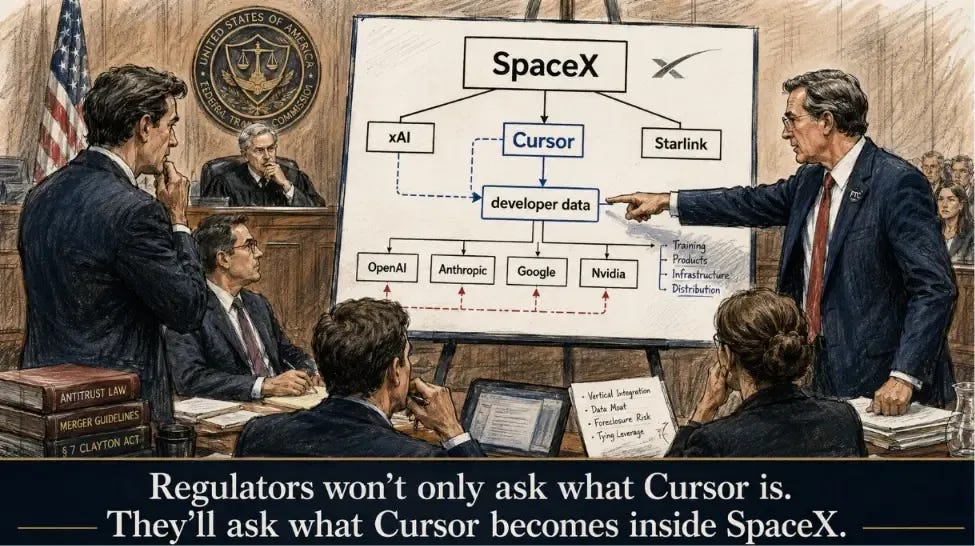
The antitrust fight won’t be simple
Regulators are going to look at this one hard.
They have to.
A newly public SpaceX, already tied to xAI, moving to acquire one of the most important AI coding platforms in the market is not a sleepy software roll-up. It touches AI competition, cloud compute access, developer data, enterprise software, and platform control.
The deal documents already reflect that reality with a separate antitrust-related fee.
The big question won’t just be “does SpaceX compete with Cursor?”
That’s too narrow. The better question is whether the deal gives SpaceX a structural advantage in AI coding that rivals can’t reasonably match.
That’s where the compute angle comes in.
Cursor needs serious infrastructure. SpaceX has been building and leasing huge compute capacity. If Cursor gets preferred access to that engine, it may be able to move faster, price harder, and ship models with a level of backing most startups can’t touch.
That sounds great if you’re Cursor.
It sounds less great if you’re a smaller AI coding startup trying to convince customers you’ll still be alive next procurement cycle.
What this deal says about the next AI war
The first AI war was about models.
Who had the smartest chatbot? Who topped the benchmark? Who could make the slickest demo video where an AI agent books a trip, writes code, edits a spreadsheet, and somehow doesn’t hallucinate the hotel address?
That phase isn’t over, but it’s getting less clean.
The next fight is about control points.
Who owns the interface?
Who owns the compute?
Who owns the workflow?
Who gets the feedback before everyone else?
The cursor sits right in the middle of that.
That’s why this deal feels bigger than a software acquisition. It’s a bet that the future of AI won’t be won by waiting for users to visit a chatbot. It’ll be won by embedding AI where work already happens.
For developers, that place is the editor.
For SpaceX, the logic is blunt: don’t wait outside the factory selling better tools. Buy the conveyor belt.
The bottom line
SpaceX’s $60 billion Cursor deal is easy to mock if you still think of SpaceX as only a rocket company.
That version is outdated.
The company is now using its public-market valuation to buy its way deeper into AI, designer tools, and business software. Cursor offers it an product developers already use, a direct line into coding workflows, and a faster path for xAI to take on OpenAI, Anthropic, Google, and Microsoft.
The deal could work.
It could also get messy fast if SpaceX overplays its hand, alienates developers, or turns Cursor into a thin wrapper around its own AI stack.
That’s the real story now. Not the $60 billion number. Not the Musk spectacle. Not even the IPO glow.
The real story is whether SpaceX can own the developer workflow without breaking the trust that made Cursor valuable in the first place.