The Delhi High Court has rejected to overturn the government's order blocking accessibility to Telegram across India, keeping the limitation in place ahead of the NEET-UG 2026 re-examination set up for June 21.
And of course, this is bigger than one messaging app.
At the center of the fight is a messy mix of exam fraud, platform accountability, student anxiety, free speech concerns, and now, a corporate sabotage allegation from Telegram founder Pavel Durov. That’s a lot for one court case to carry. But that’s exactly where we are.
The government’s argument is simple: “Telegram was being used to circulate fake or leaked exam material, and the platform wasn’t moving fast enough to stop it.”
Telegram's argument is just as direct: "you do not punish more than 150 million Indian users due to the fact that bad actors abused a couple of corners of the app."
Both sides have a point. However the blunt-force ban is what makes this story unpleasant
What the court decided
The Delhi High Court promoted the momentary constraint, accepting the federal government's disagreement that the block was legally justified under emergency powers linked to Section 69A of the Information Technology Act.
The restriction reportedly runs from June 16 to June 22, covering the days around the NEET-UG re-test.
That timing matters.
NEET isn’t some small entrance exam. It’s one of India’s most pressure-heavy national exams, and students already had to deal with the fallout of a paper leak scandal. For lakhs of aspirants, this isn’t abstract “platform regulation.” It’s their medical career, their family expectations, and years of preparation squeezed into one test window.
So I get why authorities are nervous.
But blocking an entire app because scams are spreading on it? That’s where the debate starts to get ugly.
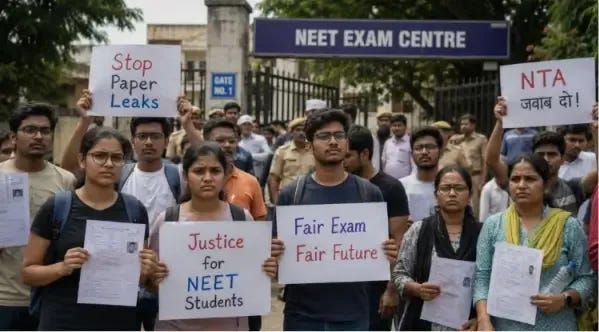
AI Generated Visual Demonstration.
The scam problem: fake leaks, edited messages, and panic selling
The National Testing Agency’s concern appears to be that fraud groups were using Telegram channels to push exam-paper scams.
One reported trick is especially annoying because it’s so believable at first glance.
Scammers allegedly used Telegram’s edit feature to make old messages look like they contained exam papers before the test. The timestamp could create the illusion that a paper had leaked earlier than it actually had.
That’s the kind of scam that works because students are scared. And when people are scared, they don’t inspect metadata like cybersecurity analysts. They panic. They pay. Then the scammers disappear.
I’ve seen people hit a wall here with all kinds of “leak” scams, not just exams. The product is usually fake. The fear is real. That’s the business model.
Think of it like a filthy conveyor belt. Even if you remove one bad package, the belt keeps moving and another one comes through unless you shut down the system or repair the sorting system. The government chose the shutdown option. Fast, visible, and politically easy to explain. But it’s also crude.
Telegram says it already acted
Telegram has argued that it removed hundreds of unlawful exam-related links and channels. The company also pushed back against the idea that a nationwide block was proportionate.
That word matters: proportionate.
Because this isn’t just about whether fraud happened. Fraud clearly needs to be stopped. The real question is whether blocking access for ordinary users is the right tool.
And that’s where Telegram’s point lands.
People use Telegram in India for study groups, creator communities, business updates, crypto groups, media distribution, private chats, customer support, and yes, plenty of messy stuff too. Telegram is not a clean platform. Anyone who has spent five minutes inside public Telegram channels knows that. Piracy, scams, fake investment groups, spammy channels — it’s all there.
But banning the whole app is still a massive move.
It’s like closing an entire highway because some drivers were speeding. You may stop the speeders for a moment, but you also trap everyone else who was just trying to get home.
Pavel Durov makes it political
Telegram founder Pavel Durov has publicly criticized the ban, saying India has punished ordinary users while the people behind leaks can simply move elsewhere.
That’s not a bad point.
If scammers are organized enough to run fake leak channels, they’re organized enough to move to WhatsApp, Signal, Discord, private websites, or some half-broken clone app by tomorrow morning. Bad actors don’t have brand loyalty. They follow the reach.
But Durov didn’t stop there.
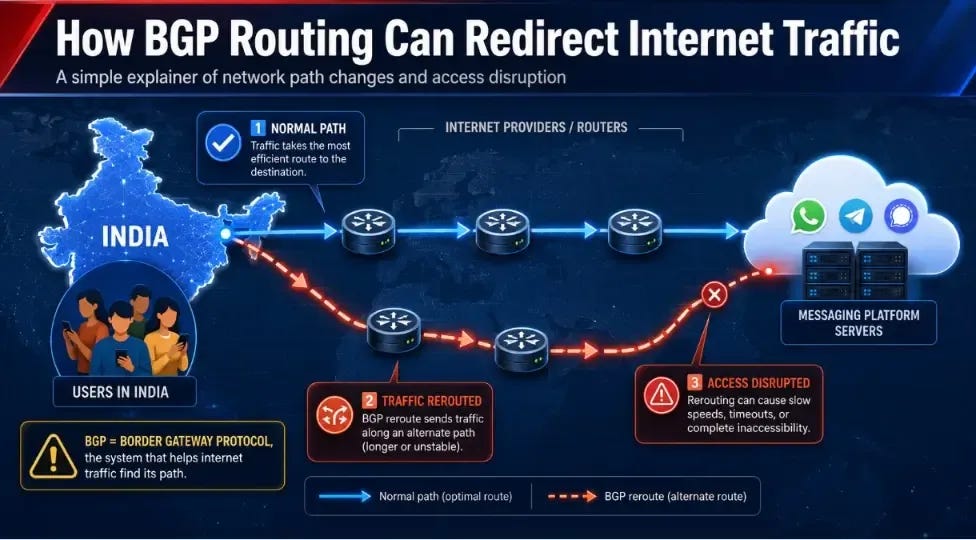
He also accused Reliance of disrupting Telegram access outside India through BGP hijacking, a routing-level internet issue that can push traffic in the wrong direction. He suggested the move may have been tied to competition, pointing at Meta’s connection to the Reliance ecosystem and WhatsApp’s rivalry with Telegram.
That’s a serious allegation.
It’s also the part where we need to slow down.
Reliance Jio has reportedly denied involvement. Technical observers have also suggested the routing issue may have been a bad configuration rather than intentional sabotage. That doesn’t make it harmless. A misconfigured network route can still break access at scale. But “broken because someone botched the routing” and “broken because a telecom giant deliberately attacked a rival” are not the same claim.
And in tech reporting, that difference matters.
The digital rights problem isn’t going away
Free speech and digital rights groups are worried this sets a precedent.
They’re right to worry.
Once a government proves it can block a major messaging app during an exam crisis, the obvious question becomes: when else can it do the same?
During elections? Protests? Communal tension? Financial panic? Public health scares?
Some of those cases may involve real risk. But emergency powers have a way of stretching. That’s the boring, annoying truth of internet governance. Tools built for “exceptional” situations often become normal once officials learn they work.
And let’s be honest: “bans are attractive to governments because they look decisive.“
Moderation is slow. Investigation is slow. Platform coordination is slow. Arresting the actual fraud networks is harder. Fixing exam security is harder. Building better digital evidence systems is harder.
A ban is quick.
That doesn’t make it smart.
The VPN spike was predictable
The other thing that was easy to see coming: people started using VPNs.
Of course they did.
When a popular app gets blocked, users don’t suddenly agree with the policy and move on with their lives. They search for workarounds. VPN downloads go up. Proxy links circulate. Telegram communities start telling members how to reconnect.
This is the cat-and-mouse video game every net restriction creates.
And it elevates a practical question: if millions of customers can bypass the block in a couple of taps, that is the ban really stopping?
Probably not the most determined scammers.
More likely, it disrupts normal users, smaller creators, students, and businesses that don’t want to mess around with VPNs just to check their messages.
What should have happened instead?
The better move would’ve been narrower enforcement.
Target the channels. Target the admins. Target payment trails. Target repeat scam networks. Force faster takedown windows for exam-related fraud. Require clearer edited-message labeling around sensitive public channels. Build a direct escalation path between NTA, cybercrime units, and Telegram’s trust and safety team.
None of that is clean or glamorous.
But it’s better than flipping the switch off for a whole country.
Telegram also doesn’t get to act like this is all someone else’s problem. The platform’s channel structure is powerful, but it’s also easy to abuse. If your product lets scam networks rebuild faster than enforcement teams can remove them, that’s not just a government headache. That’s a product design problem.
The hard answer is boring: platforms need faster abuse response, and governments need narrower tools.
Neither side loves that answer because it requires actual work.
The bigger story
This case is really about who pays the price when digital platforms are abused.
Students already paid the price when the exam system failed them. Regular Telegram users are now paying the price for the government’s response. And the actual scam operators may still be sitting somewhere, spinning up their next workflow on another platform.
That’s the part that should frustrate everyone.
A temporary ban may help the government control the immediate exam window. Maybe that’s enough for the court. But as a long-term model, it’s weak.
India needs secure exams. No argument there.
But it also needs a better playbook for platform abuse than nationwide app blocks. Because once shutdowns become the default response, we’re not just fighting fraud anymore.
We’re normalizing the idea that access can disappear whenever a platform becomes inconvenient.
And that’s a dangerous place to land.