

News Summary:
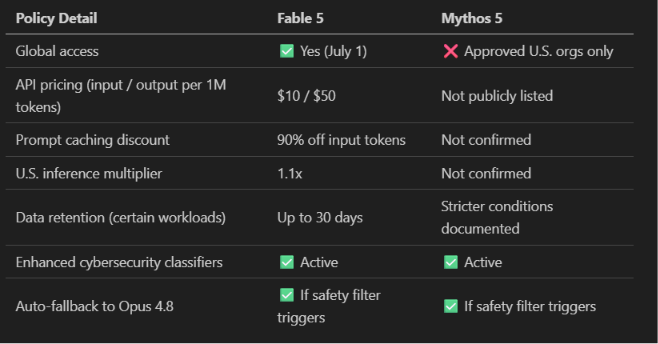
Claude Fable 5 became globally available again on July 1, 2026, after U.S. export restrictions (government rules about selling technology to other countries) were lifted on June 30.
The more restricted Mythos 5 model is only available to a specific set of U.S. organizations with government approval.
API pricing is $10 per million input tokens and $50 per million output tokens, with a 90% discount available through prompt caching (saving part of the input so the AI doesn’t re-read it).
Anthropic added new cybersecurity classifiers (safety filters) that can automatically reroute flagged requests to Claude Opus 4.8, a less powerful model.

Anthropic’s most capable public AI model is back online—but it returned with new rules. Claude Fable 5 went live worldwide on July 1 after the U.S. Department of Commerce dropped the export controls that had shut it down on June 12. The model is powerful. It’s also expensive, newly filtered, and subject to data-retention policies that your compliance team needs to read before you deploy it.
What Happened: The Export Ban and the Lift
On June 12, 2026, the U.S. government issued an export control directive, an official order that restricted the technology it could share with other countries. That order forced Anthropic to suspend access to both Claude Fable 5 and the more advanced Claude Mythos 5 for users outside approved channels.
The restriction lasted about two and a half weeks. On June 30, the U.S. Department of Commerce lifted the directive. Anthropic began restoring Fable 5 access the very next day, July 1.
But the two models didn’t come back equally. Fable 5 is globally available. Mythos 5 is available only to a specific set of U.S. organizations that received government approval. It is stated that Anthropic is collaborating with the government to expand that list.
This is important as it sets a precedent (a model that future decisions may follow). A government can turn off an AI model for millions of users in a single day. And when it comes back, it may come back with restrictions that didn’t exist before.
How Much Claude Fable 5 Costs and What You Actually Pay
The published API price is straightforward: $10 per million input tokens and $50 per million output tokens. That makes Fable 5 exactly twice the cost of Claude Opus 4.8, which sits at $5/$25.
Anthropic offers a 90% discount on input tokens through prompt caching. If you’re running repetitive tasks with a large shared context—like analyzing the same document library over and over—caching can bring your effective input cost down to roughly $1 per million tokens.
There’s a catch for U.S.-specific workloads. If your inference (the process of getting an answer from the model) must happen in the United States, Anthropic applies a 1.1x pricing multiplier on both input and output tokens. That bumps your effective rate to $11 input / $55 output per million tokens.
The model is also available through cloud providers like AWS (Amazon Bedrock), Google Cloud, and Microsoft Foundry, each of which may add its markup or offer its own volume discounts.
Through July 7, 2026, Fable 5 usage is capped at 50% of weekly usage limits for Pro, Max, Team, and select Enterprise plans. After that date, usage transitions to a credit-based system. Anthropic hasn’t published the full credit-pricing details yet.
The Data Retention Policy You Can’t Afford to Skip
Here’s the detail that matters more than any benchmark score.
Anthropic’s documentation states that certain Mythos-class traffic (requests handled by the most powerful models) can carry a 30-day data retention period. That means Anthropic may store the data you send through the model for up to 30 days.

For a solo developer testing code snippets, that’s probably fine. For a company handling customer records, financial data, legal documents, health information, or proprietary business logic, 30-day retention creates a compliance question that requires a legal review.
The key questions your team should ask before deployment:
What data is retained? All input/output, or only flagged requests?
Where is it stored? Which data center, which country, and which jurisdiction (whose laws apply)?
Who can access it? Anthropic staff, government agencies with subpoenas, or nobody?
Can you opt out? Is there a zero-retention API tier for enterprise customers?
Does retention differ between Fable and Mythos? Anthropic documents different conditions for each.
If you are unable to answer these questions from the official documentation, please refrain from deploying the model on sensitive workloads until you have the necessary information.
The Safety Filter That Can Silently Change Your Output
Anthropic redeployed Fable 5 with enhanced cybersecurity classifiers—safety filters designed to block requests that the system judges as potentially harmful, particularly in cybersecurity-related domains.
That sounds reasonable in principle. But here’s the operational risk most people miss.
If your prompt triggers the new classifier, the system doesn’t just block your request. It can automatically reroute your request to Claude Opus 4.8—a less powerful, less expensive model. You may not realize the rerouting happened unless you’re checking which model actually processed your query.
That means your output quality and your cost can both change in the middle of a workflow, without warning. If you’re running batch processing (sending many requests in a row), you could end up with a mix of Fable-quality and Opus-quality outputs, and you’d only know by inspecting the response metadata.
⚠️ Expert Flag: Before going live with Fable 5, run your full prompt library through the model and check which requests trigger the fallback. Document the patterns. If you’re building a product on top of Claude, your users will notice inconsistent quality—even if you don’t.
How Fable 5’s Return Changes Your AI Tool Choices
Here’s what this decision means if you’re not an AI engineer.
If you’re a marketer or agency operator, Fable 5’s return gives you access to one of the most capable AI research and writing models available. You can use it for deep competitive analysis, long-form content drafts, data synthesis (combining information from many sources into one summary), and multi-step campaign planning. But your clients’ data policies need to allow 30-day retention. Ask before you paste their proprietary information into a prompt.
If you’re a startup founder, more model choice sounds fantastic—until you see the bill. At $50 per million output tokens, a careless deployment that generates many long responses can burn through budget fast. The 90% caching discount helps, but only if your workload structure supports it. Use Fable 5 for the hard tasks. Route the easy ones to cheaper models like GLM-5.2 or Opus 4.8.
If you run affiliate or growth content, this is a high-search-volume moment. People are searching for “Claude Fable 5 pricing,” “Claude Fable 5 vs GPT,” “is Claude Fable 5 available,” and “Claude data retention policy.” “That’s four distinct content pieces from one news event. (Editorial analysis)
Key Dates and Decisions to Watch After July 7
Three things will shape this story over the next month.
The credit-based pricing transition. After July 7, Anthropic shifts Fable 5 from percentage-based usage limits to a credit system. The details of that system—how credits are earned, purchased, or allocated—will determine whether Fable 5 remains affordable for mid-tier teams or becomes a premium tool only large enterprises can sustain.
Mythos 5 access expansion. Anthropic says it’s working with the U.S. government to expand Mythos 5 access beyond the current approved list. If Mythos becomes broadly available, it could shift the competitive picture again. But the political uncertainty around AI export controls means that timeline is unpredictable.
Competitor responses. GLM-5.2 is gaining ground at the budget end. Google’s Gemini models are competing at the premium end. Anthropic’s ability to hold its position depends on whether Fable 5 delivers measurably better results on high-stakes tasks—not just benchmark scores, but real production outcomes that justify the 5–10x price premium.
Fable 5 Is Available—But “Available” Isn’t the Whole Story
Claude Fable 5 is back, and that’s welcome news for the AI ecosystem. More model choice means more competition, which means better tools and eventually lower prices for everyone.
But this episode also showed something uncomfortable: a government directive can take a globally used AI model offline in a single day. And when it comes back, it comes back with new filters, new retention rules, and new pricing structures that didn’t exist before.
The lesson isn’t “don’t use Fable 5.” The lesson is “don’t build your entire product on a single model from a single provider, subject to a single government’s export policies.” Diversify your model stack the same way you’d diversify any critical supply chain.
Your next step: build a compliance comparison matrix for Fable 5 vs. your current model. Cover access, retention, safety filters, fallback behavior, pricing (including the U.S. multiplier and caching discounts), and export-control risk. Then make your decision based on your specific compliance environment—not on a headline.